



October 2026
Harsh Agarwal, Global Strategy Associate
Brian Rehling, CFA, Co-Head of Global Fixed Income and Digital Asset Strategy
Mason Mendez,Global Real Assets Analyst
Bitcoin halving cycle
Key takeaways
- Bitcoin's halving cycle is a pre-programmed feature that reduces its supply growth roughly every four years, reinforcing its scarcity and fixed supply structure.
- While Bitcoin has historically experienced strong gains around halving cycles, the impact of each successive halving appears to be diminishing as most bitcoins have already been mined, the market has grown significantly larger, and institutional participation has increased.
- We believe future Bitcoin performance is likely to depend less on supply reductions alone and more on factors such as adoption, investor demand, regulation, and the broader macroeconomic environment.
As Bitcoin's next halving approaches in April 2028, investors are once again turning their attention to one of the cryptocurrency's most closely watched events. Occurring roughly every four years, a halving is a pre-programmed event that cuts the reward miners receive for validating transactions and adding new blocks to the blockchain by 50%, thereby slowing the creation of new bitcoins (see Chart 1). While past performance is no guarantee of future results, the consistency of this pattern has made every halving a closely watched milestone. Understanding what a halving is, why it matters, and why its impact appears to be evolving could help investors better navigate the years leading up to 2028.
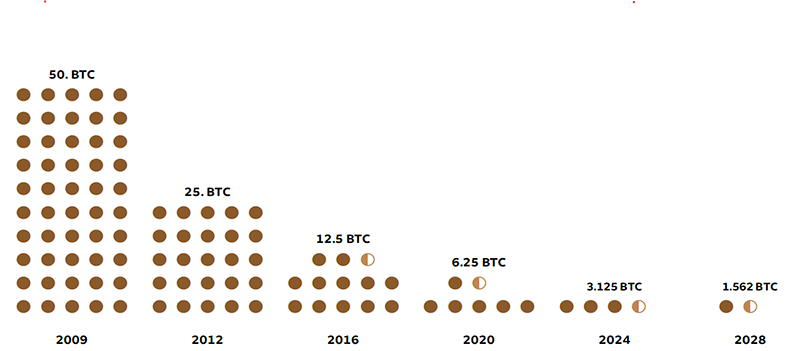 Sources: Coinmetrics website and Wells Fargo Investment Institute. Calculations as of October 13, 2026. BTC = Bitcoin. Past performance is no guarantee of future results.
Why does halving matter?
At its core, Bitcoin halving is designed to preserve scarcity. A useful comparison is gold: Part of gold's value comes from the fact that new supply is difficult and costly to produce. If unlimited amounts of gold suddenly became available, its scarcity, and much of its perceived value, would disappear. Bitcoin applies the same principle in digital form. By steadily reducing the number of new coins entering circulation, the network slows supply growth and reinforces Bitcoin's reputation as a scarce asset with a fixed supply of approximately 21 million coins.1
New bitcoins are created through a process called mining. Miners use computing power to verify transactions and hence add new blocks to the blockchain, earning newly created bitcoins known as the block reward.2 When Bitcoin launched in 2009, the reward was 50 Bitcoin (BTC) per block.3 However, Bitcoin's creator built a rule into the protocol that cuts this reward in half every 210,000 blocks, roughly every four years. The reward has since fallen from 50 BTC to 25 BTC, then to 12.5 BTC, 6.25 BTC, and most recently to 3.125 BTC (see Chart 1). This process, known as Bitcoin halving, continues automatically according to the protocol's rules and is not controlled by miners, developers, or governments. Similar to a gold mine with a fixed amount of gold, scarcity increases not only because supply is finite, but also because new supply becomes progressively more difficult to obtain. Likewise, Bitcoin’s supply capped at 21 million coins and as fewer new bitcoins are created over time, supply growth becomes increasingly limited, strengthening Bitcoin's appeal to investors who view it as a scarce store of value.
Why halving happens every four years?
Bitcoin's halving schedule is based on blocks, not calendar dates. The rule is simple that after every 210,000 blocks, the reward paid to miners is cut in half.4 While this is often described as occurring every four years, that timing is only an estimate.
A natural question is whether advances in mining technology could speed up the process and cause halvings to arrive sooner. The answer is no. Bitcoin was specifically designed to keep new blocks being added at a relatively steady pace of about one every ten minutes. If more miners join the network and computing power increases, Bitcoin automatically makes mining more difficult. If mining activity declines, the difficulty is reduced. This self-correcting system helps keep block creation on a relatively predictable schedule regardless of improvements in hardware.
As a result, it takes roughly 210,000 blocks multiplied by ten minutes per block, or about four years, to reach the next halving. Bitcoin's future issuance schedule is known in advance, reinforcing its reputation as a scarce and transparent asset.
How long will the halving continue?
A bitcoin can be divided into increasingly smaller fractions. At first, it may seem that Bitcoin halvings could continue forever. One might assume that the reward could keep being split indefinitely, allowing the halving process to continue for eternity.
In a sense, it almost does. However, Bitcoin has a limit and the smallest amount that can exist on the network is 0.00000001 bitcoin (one-hundred millionth), meaning the issuance of bitcoin cannot be reduced indefinitely. Because halvings occur only once every 210,000 blocks, this point is not expected to be reached until around 2140. By then, nearly all of Bitcoin's maximum supply of 21 million coins will have been issued, and miners will rely primarily on transaction fees rather than newly created bitcoins for revenue.
Chart 2 shows Bitcoin's issuance schedule has been heavily front-loaded because during the first four years of the network, miners received substantial reward of 50 BTC for every block mined. Although each halving occurs after the same 210,000-block interval (roughly every four years), the significantly larger rewards in Bitcoin’s early years led to a disproportionate amount of supply being issued during the initial stages of the network. As a result, approximately 10.5 million bitcoins, or 50% of the maximum supply, had already been created by the first halving in 2012. By the 2024 halving, nearly 94% of all bitcoins had already been issued. By the 2028 halving, that figure is expected to exceed 96%, illustrating how quickly Bitcoin's supply growth slows over time.
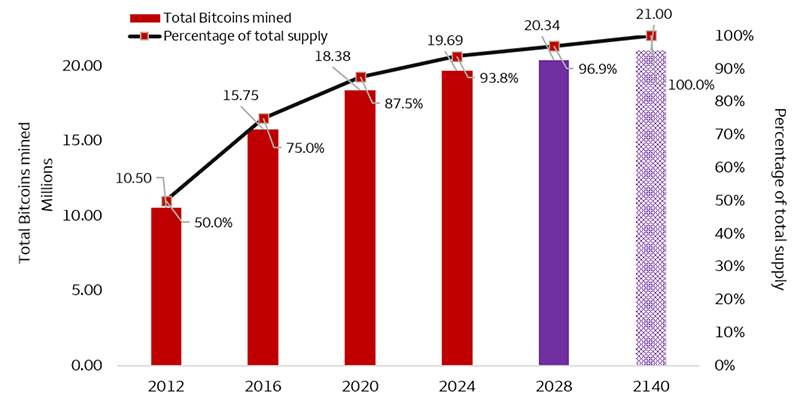 Sources: Bloomberg and Wells Fargo Investment Institute. Data as of October 13, 2026. Forecasts are not guaranteed and based on certain assumptions and on views of market and economic conditions which are subject to change.
This illustrates an important point for investors. While halvings will continue for more than a century, most bitcoins have already been created. Each successive halving reduces the supply of new coins by a smaller amount than the one before it. As a result, we believe the direct supply impact of future halvings is likely to be limited, a point we examine more closely in the next section.
Do all crypto coins halve?
Cryptocurrencies use a variety of approaches to manage supply. Some coins follow schedules similar to Bitcoin's and periodically reduce mining rewards. Others, including Ethereum, use different issuance mechanisms that do not rely on halvings. As a result, Bitcoin's halving cycle is not a feature of the cryptocurrency market as a whole, but it is rather a unique aspect of Bitcoin's design that gradually slows the creation of new coins over time and contributes to its reputation as a scarce digital asset.
Performance analysis
 Sources: Bloomberg and Wells Fargo Investment Institute. Data as of October 13, 2026. Past performance is no guarantee of future results.
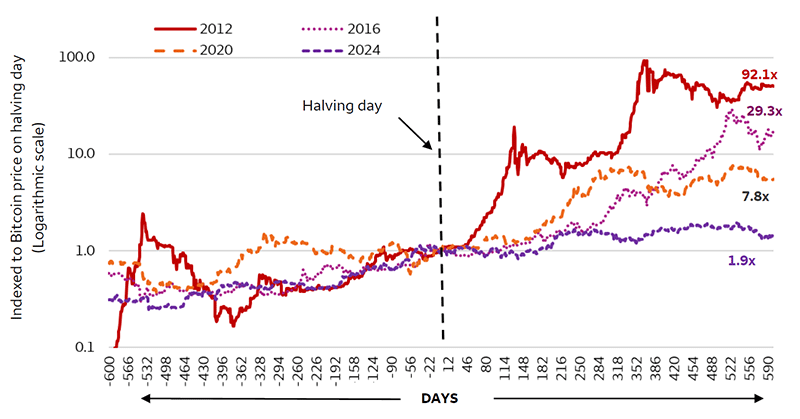
While past performance does not guarantee future results, previous cycles provide useful context for understanding market expectations and investor behavior. Bitcoin has historically experienced strong price appreciation around halving cycles. We believe, since halvings occur on a known schedule, markets begin pricing in part of the expected decline in new bitcoin issuance well before it takes place. Increased media attention surrounding each halving also reinforces Bitcoin's scarcity narrative and attracts additional investor interest following the halving event. As shown in Table 1, these dynamics have coincided with substantial post-halving gains, with Bitcoin appreciating approximately 92.1x following the 2012 halving, 29.3x after the 2016 halving, 7.8x after the 2020 halving, and 1.9x following the 2024 halving to date.
For investors, the key question is not simply how much new supply is reduced with each halving, but whether halvings have historically been associated with recurring patterns in Bitcoin's price behavior (see Table 1). Previous cycles have generally featured a trough roughly 520 days before the halving, followed by a recovery phase leading into the event, stronger price appreciation afterward, a peak roughly 550 days after the halving, and a significant correction that follows. Although the size of these moves has varied, the timing and progression of the cycle have remained surprisingly consistent across different market environments.
| Year | Peak after halving | Drawdown after peak | Days from pre-halving trough to halving | Days from halving to peak |
|---|---|---|---|---|
| 2012 | 92.1x | -84% | -757 days | 366 days |
| 2016 | 29.3x | -83% | -543 days | 525 days |
| 2020 | 7.8x | -77% | -514 days | 547 days |
| 2024 | 1.9x | -53% | -516 days | 534 days |
Sources: Bloomberg and Wells Fargo Investment Institute. Daily data is calculated from May 18, 2011 - June 30, 2026. Past performance is no guarantee of future results.
The more notable change has been the declining magnitude of returns and drawdowns. Cycle gains have fallen from roughly 92x during the 2012 cycle to less than 2x in the current cycle, while peak-to-trough declines have narrowed from about 84% to 53%. In other words, the cycle remains intact, but its amplitude has become smaller.
Several factors help explain this trend. First, each halving now affects a much smaller share of Bitcoin's total supply. At the 2012 halving, roughly half of all bitcoins that will ever exist remained unissued, meaning a 50% cut to issuance represented a substantial reduction in new supply. By the 2024 halving, the picture had changed considerably: Approximately 94% of Bitcoin's total supply had already been mined, leaving only about 6% still to be issued. Halving that remaining 6% has a far smaller effect on overall supply than halving the 50% available in 2012. By the next expected halving in 2028, only around 3% of total supply will remain unissued, further reducing the impact of the event.
Second, Bitcoin has grown substantially in size. Its market capitalization has expanded from roughly $130 million in 2012 to more than $1.7 trillion today. As a result, generating the same returns seen in earlier cycles would require substantially larger capital inflows.
Third, investor base has also changed considerably. Early Bitcoin cycles were driven primarily by retail investors trading on lightly regulated platforms, with limited institutional participation and few established investment products. Today, Bitcoin exposure is available through regulated exchange-traded products and traditional brokerage accounts, while institutional ownership has become increasingly common.5 A larger and more diversified ownership base may potentially result in a more stable market, which we believe may help reduce both extreme advances and extreme declines.
Implication for investors
While Bitcoin's halving cycle has historically followed a surprisingly consistent pattern, the magnitude of both gains and losses has declined as the assets have matured. This moderation reflects several structural changes: A shrinking share of unissued supply, a much larger market capitalization, and a broader investor base that now includes institutional participants alongside retail investors. We view this trend as broadly constructive. Smaller drawdowns reduce the risk of severe capital losses and we believe may potentially support greater participation from long-term investors, contributing to a deeper and more liquid market. The trade-off, however, is that the extraordinary returns achieved during Bitcoin's earliest cycles are becoming increasingly difficult to replicate. While we believe halving events may continue to serve as important milestones in Bitcoin's market cycle, future performance is likely to depend less on supply reductions and more on factors, such as adoption, investor demand, regulation, and the broader macroeconomic environment.
1 Wikipedia, “Bitcoin,” as of October 14, 2026.
2 Wells Fargo Investment Institute, “Blockchain technology basics,” November 13, 2025.
3 Coinbase, “What is bitcoin halving?” as of October 14, 2026.
4 Bitcoin website, “Bitcoin halving countdown.,” as of October 14, 2026.
5 Fidelity, “Is Bitcoin’s four-year cycle over?” February 24, 2026.
Risks Considerations
All investing involves risks, including the possible loss of principal. There can be no assurance that any investment strategy will be successful and meet its investment objectives. Investments fluctuate with changes in market and economic conditions and in different environments due to numerous factors, some of which may be unpredictable.
Cryptocurrency and other digital assets often involve significant risks and can be highly volatile. Their value may fluctuate substantially, and investors could lose all or a significant portion of their investment. Digital assets may be subject to market, liquidity, regulatory, and operational risks and may be subject to heightened risks of fraud, cyber incidents, and market manipulation. Digital assets may not provide the same regulatory protections as traditional investment products and often are not insured by the Federal Deposit Insurance Corporation (FDIC), the Securities Investor Protection Corporation (SIPC), or any government agency. Investors should carefully consider their investment objectives, risk tolerance, and financial circumstances before investing in cryptocurrency or other digital assets.
Investments in gold and gold-related investments tend to be more volatile than investments in traditional equity or debt securities. Such investments increase their vulnerability to international economic, monetary and political developments. They are also exposed to the risk of severe price fluctuations in the price of gold bullion.
General Disclosures
Global Investment Strategy (GIS) is a division of Wells Fargo Investment Institute, Inc. (WFII). WFII is a registered investment adviser and wholly owned subsidiary of Wells Fargo Bank, N.A., a bank affiliate of Wells Fargo & Company.
The information in this report was prepared by Global Investment Strategy. Opinions represent GIS’ opinion as of the date of this report and are for general information purposes only and are not intended to predict or guarantee the future performance of any individual security, market sector or the markets generally. GIS does not undertake to advise you of any change in its opinions or the information contained in this report. Wells Fargo & Company affiliates may issue reports or have opinions that are inconsistent with, and reach different conclusions from, this report.
The information contained herein constitutes general information and is not directed to, designed for, or individually tailored to, any particular investor or potential investor. This report is not intended to be a client-specific suitability or best interest analysis or recommendation, an offer to participate in any investment, or a recommendation to buy, hold or sell securities. Do not use this report as the sole basis for investment decisions. Do not select an asset class or investment product based on performance alone. Consider all relevant information, including your existing portfolio, investment objectives, risk tolerance, liquidity needs and investment time horizon. The material contained herein has been prepared from sources and data we believe to be reliable but we make no guarantee to its accuracy or completeness.
Wells Fargo Advisors is registered with the U.S. Securities and Exchange Commission and the Financial Industry Regulatory Authority, but is not licensed or registered with any financial services regulatory authority outside of the U.S. Non-U.S. residents who maintain U.S.-based financial services account(s) with Wells Fargo Advisors may not be afforded certain protections conferred by legislation and regulations in their country of residence in respect of any investments, investment transactions or communications made with Wells Fargo Advisors.
Wells Fargo Advisors is a trade name used by Wells Fargo Clearing Services, LLC and Wells Fargo Advisors Financial Network, LLC, Members SIPC, separate registered broker-dealers and non-bank affiliates of Wells Fargo & Company.