



October 27, 2026
Tony Miano, CFA, CAIA, Global Fixed Income Analyst
Paul Christopher, CFA, Head of Global Investment Strategy
Filtering the noise on “Sell America”
Key takeaways
- Since early 2025, a recurring “Sell America” narrative has suggested that global investors are abandoning U.S. stocks, bonds, and the U.S. dollar. Recent Treasury debt issuance has returned as an investor concern, and the Treasury’s August decision to increase buybacks of its debt added to those worries.
- Foreign pension funds and central banks have reduced U.S. Treasury security holdings, which helped the 30-year Treasury bond yield reach its highest level (5.64% on September 29, 2026) since June 2002. But foreign private investors have stepped in, so that total global official U.S. dollar holdings rose between January 2025 and July 2026.
What it may mean for investors
- We illustrate in this report that the U.S. dollar’s increased competition has not significantly dented the holding of U.S. dollars or the U.S. dollar’s preeminence in global transactions.
- The global importance of the U.S. dollar and U.S. dollar-denominated assets buffers U.S. markets and is likely a structural factor helping demand for U.S. debt and equities. “Sell America” seems greatly exaggerated.
U.S. policy uncertainty, trade tensions, sanctions, and the greater use of local currencies around the world have raised questions about the U.S. dollar’s long-term role. Yet, the evidence does not show a broad retreat from the U.S. dollar or U.S. financial markets. We illustrate in this report that factors impacting the U.S. dollar and the rise of competing currencies have not significantly reduced the holding of U.S. dollars or the U.S. dollar’s importance in global transactions.
Policy uncertainty has not dented international investor demand for the U.S. dollar
Chart 1 illustrates that foreign investors purchased or sold U.S. securities most aggressively around Federal Reserve (Fed) interest-rate policy cycles (2006, 2018, and 2023) since 1981. Foreign investors tended to buy U.S. dollars on rising interest rates, and conversely sold them when rates fell. The source of the 2025 cycle was a little different. Foreign investors ignored the Fed’s three interest rate cuts in 2024 and bought a record amount of U.S. assets in the fourth quarter of 2024, according to U.S. Treasury data. The launch of China’s DeepSeek artificial intelligence (AI) product in January 2025 and the announcement of U.S. tariffs three months later temporarily reversed that buying. However, by year-end 2025, foreign investor purchases rebounded to a record exceeding $1.5 trillion.
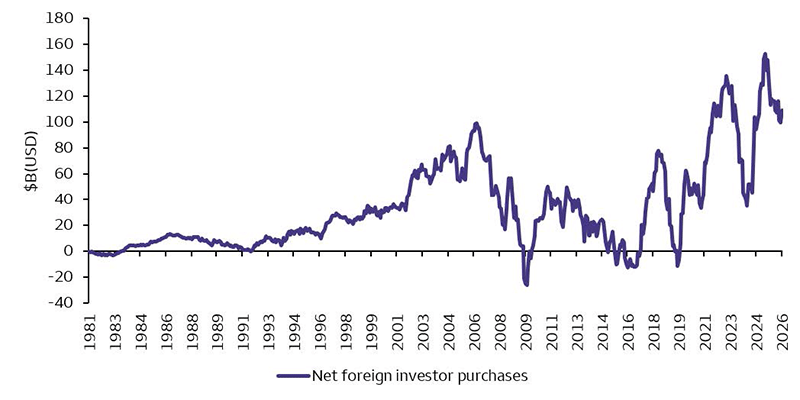 Sources: Bloomberg and Wells Fargo Investment Institute. Monthly data as of July 31, 2026. Measured by 12-month rolling average monthly net inflows from U.S. Treasury International Capital data. B = billions. USD = U.S. dollars.
The chart also shows that the latest cycles have revolved around a longer-term uptrend in foreign buying since 2020, and Treasury data shows that much of the trend has been driven by private purchases of U.S. securities. Foreign governments were slightly net sellers of U.S. Treasury securities for the 18 months ended July 2026, while private investors were net buyers of nearly $600 billion in Treasuries.1 Even following the U.S. Treasury’s August 19, 2026, buyback announcement and reflexive market fears that this was a prelude to default or the debasement of the U.S. dollar to pay off debt, 10- and 30-year U.S. Treasury auction results through October 9 showed continued foreign demand.
Our previous report from May 2025, “The dollar’s role as an international currency,” noted that as economies grow and trade relationships broaden, other currencies naturally gain usage. But currency diversification is not the same as U.S. dollar rejection. Bank for International Settlements data (see Table 1) show that the U.S. dollar remains deeply embedded as the clear currency of choice in international transactions, with usage several times that of most competing currencies.
| Currency | Share of Global FX Turnover (%) |
|---|---|
| U.S. dollar (USD) | 89.1% |
| Euro (EUR) | 28.5% |
| Japanese yen (JPY) | 16.9% |
| Pound sterling (GBP) | 10.2% |
| Chinese renminbi (CNY) | 8.6% |
| Swiss franc (CHF) | 6.3% |
Foreign official buyers have lightened but not liquidated U.S. dollar holdings
The Society for Worldwide Interbank Financial Telecommunication (SWIFT) system provides a secure, global messaging network that financial institutions in over 200 countries use to make international payments.2 The U.S. dollar’s dominant global role gives the U.S. government leverage to compel the system to disconnect the countries that fall under U.S. government sanctions.3 Some countries have developed alternatives to SWIFT to reduce their exposure to U.S. sanctions. However, these systems connect fewer institutions and lack SWIFT’s global reach and liquidity, making them more likely to serve as secondary channels than replacements.
Another fear is that China may sell large amounts of U.S. Treasury securities and so undercut the prices of U.S. Treasury securities. The July 2026 U.S. Treasury data on foreign ownership of Treasury debt show that China has nearly $630 billion in official holdings of U.S. Treasuries.4 Other data show that China holds more than $3.4 trillion in foreign exchange holdings, much of that denominated in U.S. dollars.5 China has gradually reduced its U.S. dollar holdings, as a rapid sale could push down prices and devalue China’s remaining Treasury holdings. In addition, few bond markets outside the U.S. would be large enough to absorb these new funds.
Meanwhile, other major holders like Japan and the U.K. have maintained or increased their Treasury positions. Treasury demand remains globally, and we see room for yields to rise. The reescalation of the Gulf war after June 2026 has contributed to higher yields across the globe. U.S. political volatility is a real risk, but global investors still appear to see no better alternative than U.S. assets and the U.S. dollar. Chart 2 shows that the total holdings of U.S. Treasuries have increased over the past six years.
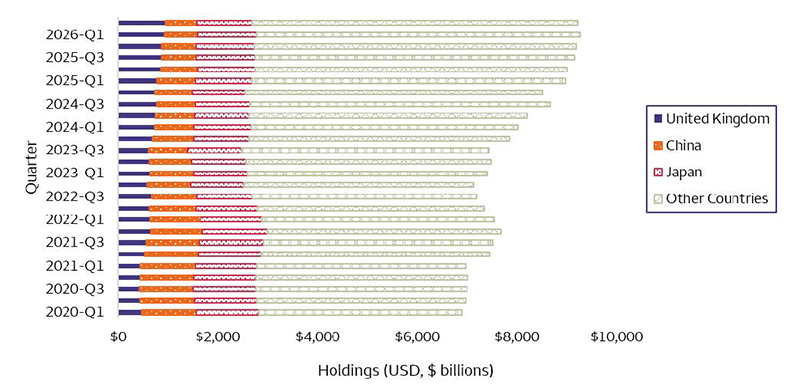 Sources: Treasury International Capital Data and Wells Fargo Investment Institute. Quarterly data as of June 30, 2026. Represents holdings of U.S. Treasury bonds by foreign investors, including private and institutional. Q1 = first quarter. Q3 = third quarter. USD = U.S. dollars.
The U.S. dollar’s advantages seem substantial
Global availability also matters. As Chart 3 shows, the U.S. Treasury and corporate bond markets are larger than the next seven largest competitors combined. Foreign investors purchasing these assets create demand for U.S. dollars, while the large supply of U.S. dollar-denominated securities makes the currency broadly available and inexpensive to trade. Smaller bond markets are less able to absorb new funds, ensuring that global investors must continue to invest new funds in the U.S. In other words, U.S. markets are attractive, in part, because market size matters.
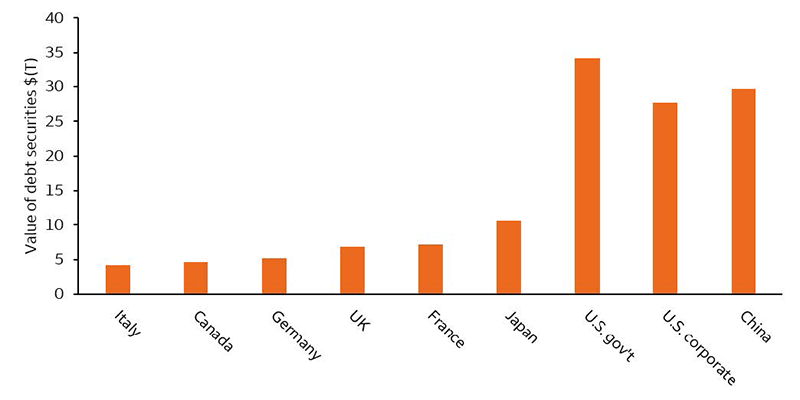 Sources: Bank for international Settlements and Wells Fargo Investment Institute. Quarterly data as of March 31, 2026 (latest available). T = trillions. Gov’t = government.
Foreign governments and businesses even issue U.S. dollar-denominated debt. The total amount outstanding of U.S. dollar debt by foreign issuers was almost $16 trillion, according to Bank for International Settlements (latest data from June 2026). This extensive network reinforces the U.S. dollar’s convenience for international trade and helps explain why it appears on one side of 89% of foreign exchange transactions (see Table 1).
Are perceived safe havens good dollar substitutes?
Some investors view rising gold prices as a sign of reduced foreign confidence in the U.S. dollar, but other explanations fit the data better. Turkey, for example, was a leading buyer of gold in 2025, but we believe those purchases were to build its reserves to counter its persistent inflation problem.6 Separately, Poland led all countries in 2025 in official gold purchases and maintained its lead year-to-date through August 2026, according to World Gold Council data. The central bank has proposed building a gold supply to sell at higher prices, with a stated goal to secure U.S. dollars to fund military expansion against possible Russian aggression.7 Russia and China may have political reasons to cut U.S. dollar holdings, but Chart 4 illustrates that Poland and Turkey are not special cases. Since 2023, foreign governments in aggregate are increasing their U.S. dollar holdings and their gold holdings.
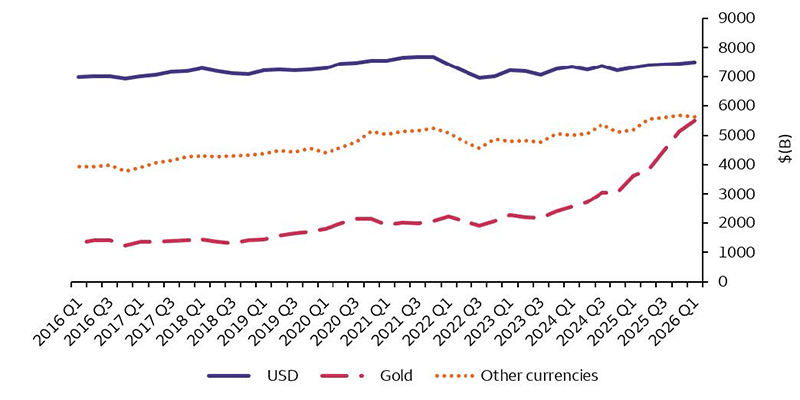 Sources: Bloomberg Intelligence and Wells Fargo Investment Institute. (Latest) quarterly data as of March 31, 2026. Measures reserve holdings of central banks. Other currencies include global currencies such as the euro, yen, British pound, and others. B = billions. Q1 = first quarter. Q3 = third quarter. USD = U.S. dollars.
The magnitude of the explosion of gold in 2025 (70% of its total increase in price since 2020) may partially be blamed on other factors. Retail investment fund gold purchases rivaled central bank gold buying during gold’s 2024-2025 price surge. But as gold prices dropped sharply after the Iran war began, investment fund holdings unwound rapidly, suggesting that their motive was speculative, rather than an effort to replace U.S. dollars.
The Swiss franc offers another example of the risks of relying on simple perceived safe-haven narratives. The franc depreciated 7.2% against the U.S. dollar between February 27 and October 2, 2026, as lower Swiss inflation and interest rates made higher-yielding currencies more attractive. The experience supports our broader caution against basing investment decisions on a single theme, like perceived safe havens or “Sell America” narrative.
Looking beyond headline fears
The “Sell America” arguments we have heard typically start with the premise that the U.S. is no longer an attractive investment destination for foreign investors. Our work rejects that assumption. We do not see a broad move to abandon the U.S. dollar or U.S. financial markets. The sheer size of U.S. markets and the availability of U.S. dollars give the dollar a cost advantage that is still broadly taken, whether in trade or in the steady rise of foreign official debt issuance in U.S. dollars. Ultimately, foreign governments may have particular (and likely political) reasons for selling U.S. assets or holding more gold, but their reasons seem idiosyncratic, not a systematic avoidance of the U.S. and not a consistent headwind for the U.S. assets or the U.S. dollar. In our view, the “Sell America” argument confuses a few odd trees for a much larger and healthier forest.
1 Treasury International Capital data as of June 30, 2026. Foreign non-official investors purchased $638 billion net of U.S. Treasuries since January 2025 while foreign official investors sold $31.9 billion net.
2 Please see “What is SWIFT?” Society for Worldwide Interbank Financial Telecommunication, October 2, 2026.
3 U.S. sanctions on Russia after its 2022 invasion of Ukraine included disconnecting Russian banks from the SWIFT system.
4 Data on China’s holdings of U.S. Treasuries from Treasury International Capital. Data as of July 31, 2026.
5 China State Administration of Foreign Exchange, via Bloomberg as of August 31, 2026 (latest data).
Risks Considerations
Each asset class has its own risk and return characteristics. The level of risk associated with a particular investment or asset class generally correlates with the level of return the investment or asset class might achieve. Bonds are subject to market, interest rate, price, credit/default, liquidity, inflation and other risks. Prices tend to be inversely affected by changes in interest rates. Although Treasuries are considered free from credit risk they are subject to other types of risks. These risks include interest rate risk, which may cause the underlying value of the bond to fluctuate. Currency risk is the risk that foreign currencies will decline in value relative to the U.S. dollar. Exchange rate movement between the U.S. dollar and foreign currencies may cause the value of a portfolio’s investments to decline. Investments in gold and gold-related investments tend to be more volatile than investments in traditional equity or debt securities. Such investments increase their vulnerability to international economic, monetary and political developments.
General Disclosures
Global Investment Strategy (GIS) is a division of Wells Fargo Investment Institute, Inc. (WFII). WFII is a registered investment adviser and wholly owned subsidiary of Wells Fargo Bank, N.A., a bank affiliate of Wells Fargo & Company.
The information in this report was prepared by Global Investment Strategy. Opinions represent GIS’ opinion as of the date of this report and are for general information purposes only and are not intended to predict or guarantee the future performance of any individual security, market sector or the markets generally. GIS does not undertake to advise you of any change in its opinions or the information contained in this report. Wells Fargo & Company affiliates may issue reports or have opinions that are inconsistent with, and reach different conclusions from, this report.
The information contained herein constitutes general information and is not directed to, designed for, or individually tailored to, any particular investor or potential investor. This report is not intended to be a client-specific suitability or best interest analysis or recommendation, an offer to participate in any investment, or a recommendation to buy, hold or sell securities. Do not use this report as the sole basis for investment decisions. Do not select an asset class or investment product based on performance alone. Consider all relevant information, including your existing portfolio, investment objectives, risk tolerance, liquidity needs and investment time horizon. The material contained herein has been prepared from sources and data we believe to be reliable but we make no guarantee to its accuracy or completeness.
Wells Fargo Advisors is registered with the U.S. Securities and Exchange Commission and the Financial Industry Regulatory Authority, but is not licensed or registered with any financial services regulatory authority outside of the U.S. Non-U.S. residents who maintain U.S.-based financial services account(s) with Wells Fargo Advisors may not be afforded certain protections conferred by legislation and regulations in their country of residence in respect of any investments, investment transactions or communications made with Wells Fargo Advisors.
Wells Fargo Advisors is a trade name used by Wells Fargo Clearing Services, LLC and Wells Fargo Advisors Financial Network, LLC, Members SIPC, separate registered broker-dealers and non-bank affiliates of Wells Fargo & Company.