



September 2026
Brian Rehling, CFA, Co-Head of Global Fixed Income and Digital Asset Strategy
Mason Mendez,Global Real Assets Analyst
Can Bitcoin protect you from inflation?
Key takeaways
- Bitcoin has significantly outpaced inflation over the long term, but our view is that its weak relationship with inflation and sharp price swings mean it should not be viewed as reliable protection when inflation rises.
- While Bitcoin may not be an effective inflation hedge, a modest allocation may offer long-term return potential and diversification benefits for growth-oriented investors who understand and can tolerate the risks.
Bitcoin is often called “digital gold” because, like gold, it has a limited supply and is viewed by some investors as a potential store of value. The basic idea is straightforward: inflation reduces the dollar’s purchasing power, meaning each dollar buys less over time. By contrast, Bitcoin’s supply is capped at 21 million coins, and that scarcity has led some investors to argue that Bitcoin could hold its value, or even rise, when traditional currencies lose buying power. But a compelling story still needs to be tested against the data. We believe digital assets can have a role in well-diversified portfolios for appropriate investors, but that view should rest on the right foundation — evidence that supports why investors own them, what risks they should expect, and how large a role they should play. This report examines whether Bitcoin’s reputation as protection against inflation is supported by the evidence — and what that means for how investors should think about digital assets in a portfolio.
What an inflation hedge should do
A good inflation hedge should do two things reasonably well. First, it should rise in value when the cost of living rises. Second, it should do so without price swings so large that investors may be forced to sell at the wrong time. Cash generally fails the first test because inflation steadily reduces its buying power. Gold has historically done a better job, although not perfectly. For example, the price of gold fell 24% in the first five months of the Iran war,1 just as energy prices were driving gasoline and food prices higher, mainly because central banks sold gold to raise dollars to buy oil and refined products. Bitcoin’s record is more complicated.
The bull case: Bitcoin has outpaced inflation over the long run
Viewed over a long enough period (January 2013 – August 2026), the case for Bitcoin looks strong. Bitcoin traded near $100 in 20132, surpassed $100,000 in late 2024, reached an all-time high above $126,000 in October 2025, and ended August 2026 just below $80,000. Even after large drawdowns, that long-term gain has far exceeded the cumulative loss of purchasing power from U.S. inflation over the same period. In plain language, investors who bought Bitcoin early and held it through volatility saw purchasing power grow dramatically (see Chart 1).
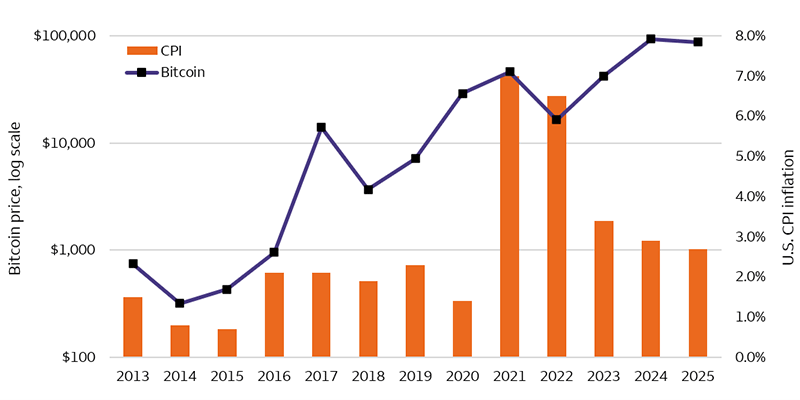 Sources: Bloomberg, U.S. Bureau of Labor Statistics, and Wells Fargo Investment Institute. Annual data is from 2013 to 2025. Consumer Price Index (CPI), a measure of inflation, is based on December-over-December percentage changes. Past performance is no guarantee of future results.
Chart 1 also highlights an important limitation: Bitcoin’s price has not moved in step with inflation from year to year. Bitcoin declined in 2014 and 2018, even as inflation stayed positive, and it fell sharply in 2022, when inflation was elevated and a reliable hedge should have been most valuable. That does not erase Bitcoin’s strong long-term return history, but it does weaken the case that Bitcoin can consistently serve as protection for investors when inflation pressures rise.
The problem is not that Bitcoin has failed to beat inflation over time. The problem is that it has not moved with inflation in a steady or predictable way. In some periods, Bitcoin rose while inflation was low or falling. In other periods, Bitcoin fell even as inflation was high. That pattern makes it hard to treat Bitcoin as reliable inflation protection. A reliable hedge should be expected to help when the specific risk shows up. Bitcoin has not shown that kind of consistency. It may still respond at times to concerns about currency debasement, central-bank policy, or long-term scarcity, but those forces have not translated into a stable relationship with inflation.
Bitcoin has been more volatile than a hedge should be
Even if Bitcoin’s average return has outpaced inflation over long horizons, an effective hedge also needs to be reliable during the periods when inflation is hurting purchasing power. This is where Bitcoin has fallen short. Bitcoin’s annualized volatility (as measured by standard deviation) from 2014 through 2026 has been 64%, compared with about 16% for gold in many periods and materially lower volatility for Treasury Inflation-Protected Securities (TIPS), which are designed to adjust with inflation (see Chart 2).3 Put simply, Bitcoin has delivered large gains at times, but it has also experienced price swings that are much larger than those of more traditional inflation-sensitive assets.
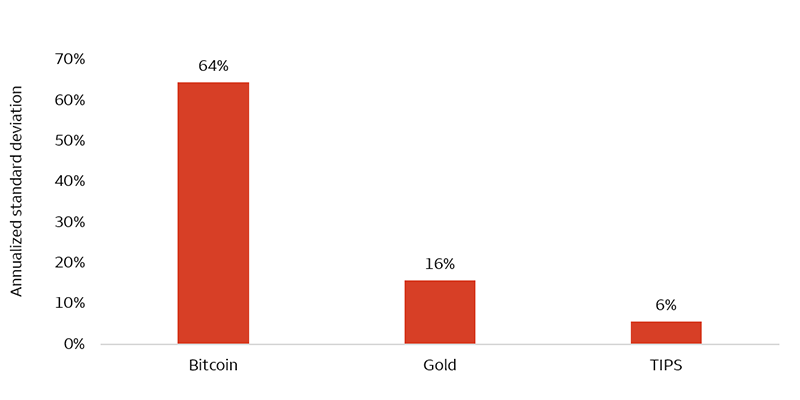 Sources: Bloomberg and Wells Fargo Investment Institute. Annualized volatility is based off daily data from January 1, 2014 – September 2, 2026. Gold and Bitcoin were both measured using their U.S. dollar spot prices. XBTUSD for bitcoin and XAUUSD for gold. TIPS = Treasury Inflation-Protected Securities. Standard deviation is a statistical measure of volatility. The higher the standard deviation, the greater volatility has been. Past performance is no guarantee of future results.
The recent test: Bitcoin still behaved more like a risk asset
The highest inflation stress came in 2022, and Bitcoin did not act like reliable inflation protection during that period. As inflation surged and interest rates rose, Bitcoin fell sharply, which weakened the case that it can consistently protect purchasing power when inflation pressure is most intense. The 2025–2026 period tells a related story, but in a different environment. Inflation remained above the Federal Reserve’s 2% target, gold reached record highs, and Bitcoin again showed large swings rather than steady protection. After reaching an all-time high above $126,000 on October 6, 2025, Bitcoin fell by roughly half and traded near the low-to-mid $60,000 range in early August 2026. That pattern is more consistent with a high-volatility risk asset than with a traditional inflation hedge, such as gold or TIPS.
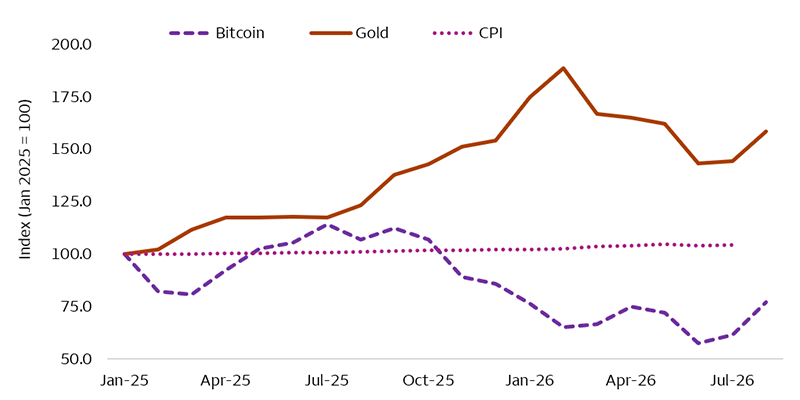 Sources: Bloomberg and Wells Fargo Investment Institute. Monthly data is from January 2025 – August 2026. Consumer Price Index (CPI) data is through July 2026. Past performance is no guarantee of future results.
Not a hedge does not mean no portfolio role
Inflation hedging and portfolio diversification are separate roles. A hedge should respond to a specific risk in a reasonably predictable way — in this case, rising prices. Bitcoin has not done that consistently. A diversifier serves a different purpose: it can add a source of return that does not always move in lockstep with stocks and bonds. On that basis, we believe digital assets can play a useful role for growth-oriented investors who understand the risks and can tolerate meaningful volatility.
Our view is that digital assets may warrant a limited role in diversified, growth-oriented portfolios — but not an outsized one. Broader access, improving regulation, and deeper integration into the financial system have made the asset class more investable. At the same time, we believe high volatility calls for modest allocations, disciplined rebalancing, and a clear focus on diversification, risk management, and long-term financial goals.
As with any emerging asset class, the path forward is unlikely to be smooth. Regulation, adoption, liquidity, and investor sentiment will continue to shape outcomes. Still, diversified portfolios should evolve as markets evolve. For investment objectives that accommodate digital assets, a small allocation may offer exposure to an emerging asset class with long-term return potential, while keeping the broader portfolio grounded in diversification and risk management.
Conclusion: Bitcoin is not a reliable inflation hedge
The data-driven answer is that Bitcoin should not be treated as a reliable hedge against inflation.
- Long run: Bitcoin’s price has risen far faster than inflation, which has grown purchasing power for investors who bought early and held through sharp volatility.
- Short-to-medium term: Bitcoin’s relationship with inflation has been weak and unreliable, and its volatility has been much higher than gold or TIPS.
- Inflation-pressure periods: Bitcoin fell sharply during the 2022 inflation surge and remained volatile during the 2025–2026 period, while gold and TIPS more directly fit the inflation-protection role.
Taken together, the evidence does not support using Bitcoin as near-term inflation protection in the same way investors often use more effective hedges, such as gold and TIPS. That said, this is not a case against digital assets altogether. For growth-oriented investors, a modest 2% to 3% allocation may be appropriate because digital assets can offer long-term return potential and diversification benefits. We believe the key is to own them for those reasons — and to size the position accordingly — rather than expecting Bitcoin to reliably protect purchasing power when inflation rises.
Risks Considerations
This document is a general communication being provided for educational purposes only. It is educational in nature and not designed to be taken as advice or a recommendation for any specific investment product or strategy. Any examples used are for illustration purposes only. This material does not contain sufficient information to support an investment decision and it should not be relied upon by you in evaluating the merits of investing in any securities or products. Any forecasts, figures, opinions, or investment techniques and strategies set out are for information purposes only, based on certain assumptions and current market conditions, and are subject to change without prior notice. All information presented herein is considered to be accurate at the time of production, but no warranty of accuracy is given and no liability in respect of any error or omission is accepted. It should be noted that all investing involves risks, the value of investments and the income from them may fluctuate in accordance with market conditions and taxation agreements, and investors may not get back the full amount invested.
Digital assets are not a physical currency, nor legal tender. Investors must have the financial ability, sophistication/experience and willingness to bear the risks of an investment, and a potential total loss of their investment. An investor could lose all or a substantial portion of his/her investment. Digital assets have limited operating history or performance. Digital assets are sometimes exchanged for U.S. dollars or other currencies around the world, but they are not backed or supported by any government or central bank. Their value is completely derived by market forces of supply and demand, and they are more volatile than traditional fiat currencies.
Cryptocurrency and other digital assets often involve significant risks and can be highly volatile. Their value may fluctuate substantially, and investors could lose all or a significant portion of their investment. Digital assets may be subject to market, liquidity, regulatory, and operational risks and may be subject to heightened risks of fraud, cyber incidents, and market manipulation. Digital assets may not provide the same regulatory protections as traditional investment products and often are not insured by the Federal Deposit Insurance Corporation (FDIC), the Securities Investor Protection Corporation (SIPC), or any government agency. Investors should carefully consider their investment objectives, risk tolerance, and financial circumstances before investing in cryptocurrency or other digital assets.
The commodities markets are considered speculative, carry substantial risks, and have experienced periods of extreme volatility. Investing in a volatile and uncertain commodities market may cause a portfolio to rapidly increase or decrease in value which may result in greater share price volatility. Investing in gold or other precious metals involves special risk considerations such as severe price fluctuations and adverse economic and regulatory developments affecting the sector or industry.
Treasury Inflation-Protected Securities (TIPS) are subject to interest rate risk, especially when real interest rates rise. This may cause the underlying value of the bond to fluctuate more than other fixed income securities. TIPS have special tax consequences, generating phantom income on the “inflation compensation” component of the principal. A holder of TIPS may be required to report this income annually although no income related to “inflation compensation” is received until maturity.
General Disclosures
Global Investment Strategy (GIS) is a division of Wells Fargo Investment Institute, Inc. (WFII). WFII is a registered investment adviser and wholly owned subsidiary of Wells Fargo Bank, N.A., a bank affiliate of Wells Fargo & Company.
The information in this report was prepared by Global Investment Strategy. Opinions represent GIS’ opinion as of the date of this report and are for general information purposes only and are not intended to predict or guarantee the future performance of any individual security, market sector or the markets generally. GIS does not undertake to advise you of any change in its opinions or the information contained in this report. Wells Fargo & Company affiliates may issue reports or have opinions that are inconsistent with, and reach different conclusions from, this report.
The information contained herein constitutes general information and is not directed to, designed for, or individually tailored to, any particular investor or potential investor. This report is not intended to be a client-specific suitability or best interest analysis or recommendation, an offer to participate in any investment, or a recommendation to buy, hold or sell securities. Do not use this report as the sole basis for investment decisions. Do not select an asset class or investment product based on performance alone. Consider all relevant information, including your existing portfolio, investment objectives, risk tolerance, liquidity needs and investment time horizon. The material contained herein has been prepared from sources and data we believe to be reliable but we make no guarantee to its accuracy or completeness.
Wells Fargo Advisors is registered with the U.S. Securities and Exchange Commission and the Financial Industry Regulatory Authority, but is not licensed or registered with any financial services regulatory authority outside of the U.S. Non-U.S. residents who maintain U.S.-based financial services account(s) with Wells Fargo Advisors may not be afforded certain protections conferred by legislation and regulations in their country of residence in respect of any investments, investment transactions or communications made with Wells Fargo Advisors.
Wells Fargo Advisors is a trade name used by Wells Fargo Clearing Services, LLC and Wells Fargo Advisors Financial Network, LLC, Members SIPC, separate registered broker-dealers and non-bank affiliates of Wells Fargo & Company.