



July 7, 2026
Brian Rehling, CFA
Co-Head of Global Fixed Income and Digital Asset Strategy
Mason Mendez
Global Real Assets Analyst
Digital Asset volatility: Portfolio implications for investors
Key takeaways
- Digital assets have historically experienced much larger price swings and deeper drawdowns than traditional investments, making realistic expectations and careful position sizing essential.
- For appropriate investors, a modest allocation may add diversification and return potential, but it should be managed within a broader portfolio using disciplined rebalancing and risk controls.
Digital assets such as Bitcoin and Ethereum remain volatile investments. Volatility measures how much an investment’s price moves up or down over time. For digital assets, those moves have typically been much larger than for traditional asset classes such as stocks, bonds, or gold. For investors, this volatility is a central consideration because it creates both the potential for meaningful gains and the risk of significant losses. We believe investors should approach digital assets with realistic expectations, disciplined position sizing, and a clear understanding of how the exposure fits within a broader portfolio.
Digital asset markets have tended to move through boom-and-bust cycles. For Bitcoin, these cycles are often discussed in relation to its roughly four-year halving events, which reduce the amount of new Bitcoin created.1 Past halvings have historically preceded periods of strong price appreciation but have not been the only driver of returns. After the 2016 halving, Bitcoin climbed from under $1,000 at the start of 2017 to nearly $20,000 by late 2017, before falling more than 80% during the 2018 bear market.2 After the 2020 halving, Bitcoin rose from below $10,000 to a high near $69,000 in 2021, before declining sharply during the 2022 crypto downturn.3 The most recent halving occurred in April 2024, while the next halving is expected around 2028.4 The key takeaway is that sharp rallies and deep pullbacks have both been recurring features of digital asset market history (see Chart 1).
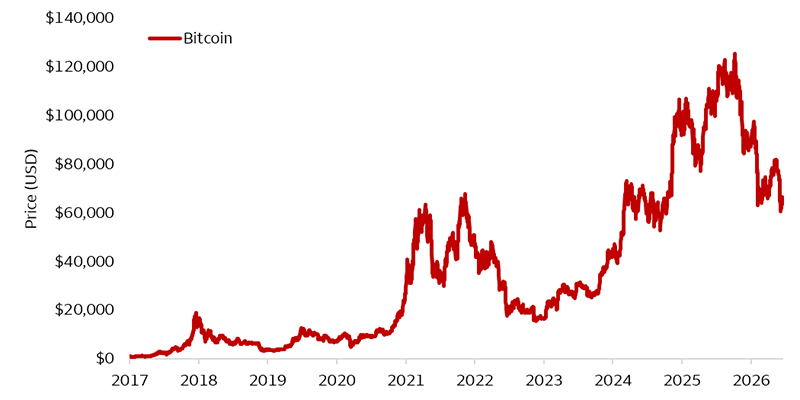 Sources: Bloomberg and Wells Fargo Investment Institute. Daily data is from January 1, 2017 – June 17, 2026. Past performance is no guarantee of future results.
Large drawdowns have been a defining feature of the asset class. A drawdown measures the decline from a prior high to a later low before a recovery begins. Bitcoin experienced a decline of roughly 83% after its 2017 peak, between December 17, 2017 and December 14, 2018, and about 77% after its 2021 peak between November 9, 2021 and November 21, 2022. Ethereum has experienced even larger drawdowns at times. By comparison, the S&P 500 fell about 57% during the 2008 financial crisis5 and about 25% during its 2022 bear market.6 These comparisons illustrate why digital asset positions should be sized carefully. Additionally, some leading digital assets, such as bitcoin, have recovered from prior downturns7 and reached new highs thereafter (see Chart 1), which is why investors should evaluate both the risks and the potential portfolio benefits before deciding whether an allocation is appropriate.
Digital asset volatility for the eight years ended June 17, 2026 was substantially higher than volatility in traditional markets. Bitcoin’s annualized volatility was often in the 50% to 80% range, compared with roughly 15% to 20% for the S&P 500 and about 10% to 15% for gold in many periods over the last eight years (see Chart 2). Put simply, major cryptocurrencies have experienced much larger and more frequent price swings than broad stock, bond, or gold markets. Price moves of 5% or more in a single day were not unusual for major cryptocurrencies during this period, while moves of that size were much less common in broad stock and bond indexes.8 Investor sentiment, regulatory developments, interest rates, economic data, leverage, liquidity, and market structure can all contribute to these swings.
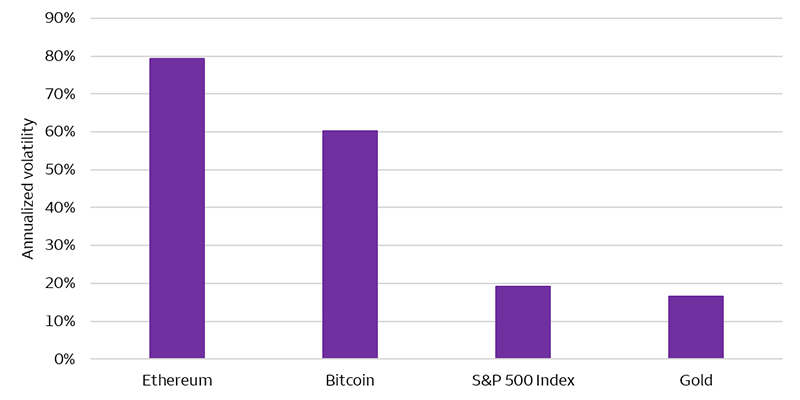 Sources: Bloomberg and Wells Fargo Investment Institute. Daily data is from June 15, 2018 – June 17, 2026. Annualized volatility is based on daily price returns.
While volatility is a defining feature of digital assets, it is not the only feature that matters for portfolio construction. For appropriate investors, a small allocation may add a source of return that behaves differently from traditional assets. Bitcoin and other leading digital assets have historically shown low correlations with stocks and bonds. Between January 2011 and June 2026, bitcoin’s monthly returns have shared a 0.18 correlation with the S&P 500 Index and a 0.07 correlation with the Bloomberg U.S. Aggregate Bond Index Over the same period, digital assets such as bitcoin have shown higher average monthly returns of 12% versus 1.2% for the S&P 500 Index and 0.2% for the Bloomberg U.S. Aggregate Bond Index, reflecting their higher return potential. This suggests that even modest allocations can positively affect long-term portfolio outcomes.9 In some historical portfolio studies, small allocations to Bitcoin or broader digital assets improved risk-adjusted returns, including Sharpe ratios, and shifted the efficient frontier higher by adding return potential without materially changing the core stock-and-bond allocation.10 These results should not be viewed as guaranteed, because they depend heavily on the time period studied, the size of the allocation, and the discipline of rebalancing. Still, they help explain why the opportunity is not simply owning a volatile asset; it is using a small, disciplined allocation in a way that may improve diversification, add growth potential, and create tactical rebalancing opportunities.
One reason investors may consider digital assets is their historically low correlation with traditional asset classes. Correlation measures how closely the returns of two investments move together. When an asset has a low correlation with stocks, bonds, or other traditional investments, it may add a different source of return and potentially help improve overall portfolio diversification. However, this benefit is not guaranteed. Correlations can change over time, and during periods of market stress, digital assets have sometimes behaved more like risk assets, falling at the same time as equities.11 For investors, this means digital assets should be viewed as a potential diversifier, not a substitute for core holdings such as stocks, bonds, and cash.
The market structure around digital assets also continues to mature. Bitcoin volatility remains high compared with stocks and bonds, but several measures suggest it has trended lower over time as market liquidity, custody, trading infrastructure, and regulated investment vehicles have improved.12 The launch of U.S. spot Bitcoin exchange-traded products in 2024 broadened access for both retail and institutional investors and helped bring digital assets further into traditional financial markets. Greater adoption does not eliminate volatility or downside risk, but it may support deeper liquidity, better price discovery, and more practical ways for investors to size and manage exposure within diversified portfolios.
For investors, managing volatility starts with realistic expectations and disciplined portfolio construction. Dollar-cost averaging, which means investing fixed amounts at regular intervals, may help reduce the risk of buying all at once near a market peak. Keeping position sizes modest — often only a small portion of a diversified portfolio — can help limit the effect of a large drawdown. Maintaining a long-term horizon is also important because selling during sharp declines can turn temporary losses into permanent ones. Diversification across stocks, bonds, cash, real assets, and other alternatives can help smooth overall portfolio results during periods when digital assets are especially volatile.
Volatility is an inherent part of financial assets, and digital assets are no exception. We do not believe elevated digital asset price volatility disqualifies their potential opportunity, but it does require disciplined position sizing and careful portfolio management. The same market forces that can support large gains can also lead to steep losses. For appropriate investors, a modest allocation may improve portfolio diversification and return potential, but only if the exposure is sized appropriately and considered within the full portfolio context. For Growth and Income and Growth portfolios, we view an allocation of approximately 2% to 3% as appropriate for investors who understand the risks and can tolerate meaningful price swings. By understanding historical cycles, recognizing the size of past drawdowns, and using sound risk-management practices, investors can be better prepared for volatility while still participating in the asset class’s potential opportunities. Past performance does not guarantee future results, but history provides useful context for setting expectations and making informed portfolio decisions.
1 “2024 Bitcoin Halving: One Year Later,” Fidelity Digital Assets. May 22, 2025.
2 Bitcoin peaked on December 17, 2017 and troughed on December 14, 2026.
3 Bitcoin peaked on December 9, 2021 and troughed on November 21, 2022.
4 “Bitcoin Halving Countdown,” Coingecko.com. June 22, 2026.
5 S&P 500 Index peaked on October 9, 2007 and troughed on March 9, 2009.
6 S&P 500 Index peaked on January 3, 2022 and troughed on October 12, 2022.
7 Prior peak to troughs measured between December 17, 2017 – December 14, 2018 and between November 9, 2021 and November 21, 2022.
8 Based on Bloomberg daily price return data from June 15, 2018 – June 17, 2026.
9 “Intro to digital assets – The investment rationale,” Wells Fargo Investment Institute. April 2026.
10 There are numerous studies by academics and global investment managers. For example, from the latter group, see Matthew Sigel, et al., "Optimal Crypto Allocation for Portfolios," VanEck website. The study finds over the period September 2015 — April 2024 that adding varying amounts up to 6% of portfolio weight to cryptocurrencies, as proxied by the Market Vector Bitcoin Index and the Market Vector Ethereum Index to a portfolio of 60% equities (proxied by the S&P 500 Index) and 40% fixed income (proxied by the Bloomberg U.S. Aggregate Bond Index) can improve the ratio of return to standard deviation (a measure of volatility) over the portfolio with only the 60%/40% allocations to equities and fixed income. In order to add the cryptocurrency component, the study reallocated in equal percentages from the equity and fixed income components. For example, a 2% allocation to Bitcoin reallocated 1% from equities and 1% from fixed income. The two Market Vector indices measure the return of a digital asset portfolio 100% invested in Bitcoin or Ethereum, respectively.
11 “Institute Alert - Adjusting targets, guidance and allocations”, Wells Fargo Investment Institute. April 6, 2026.
12 Ibid.
Risks Considerations
Each asset class has its own risk and return characteristics. The level of risk associated with a particular investment or asset class generally correlates with the level of return the investment or asset class might achieve. Stock markets, especially foreign markets, are volatile. Stock values may fluctuate in response to general economic and market conditions, the prospects of individual companies, and industry sectors.
Digital assets are not a physical currency, nor legal tender. Investors must have the financial ability, sophistication/experience and willingness to bear the risks of an investment, and a potential total loss of their investment. An investor could lose all or a substantial portion of his/her investment. Digital assets have limited operating history or performance. Digital Assets are sometimes exchanged for U.S. dollars or other currencies around the world, but they are not backed or supported by any government or central bank. Their value is completely derived by market forces of supply and demand, and they are more volatile than traditional fiat currencies.
Bitcoin is a decentralized digital asset that allows peer to peer transfer of value over the internet without a bank, using blockchain technology to record transactions.
Ethereum is a decentralized blockchain platform that enables digital payments and programmable transactions through smart contracts, using its native asset, ether (ETH), to power the network.
Diversification does not guarantee profit or protect against loss in declining markets
A periodic investment plan such as dollar cost averaging does not assure a profit or protect against a loss in declining markets. Since such a strategy involves continuous investment, the investor should consider his or her ability to continue purchases through periods of low price levels.
Definitions
Bloomberg U.S. Aggregate Bond Index is a broad-based measure of the investment grade, US dollar-denominated, fixed-rate taxable bond market.
Market Vector Bitcoin Index measures the performance of a digital assets portfolio which invests in Bitcoin.
Market Vector Ethereum Index covers the performance of a digital assets portfolio which invests in Ethereum.
S&P 500 Index is a market capitalization-weighted index composed of 500 widely held common stocks that is generally considered representative of the US stock market.
An index is unmanaged and not available for direct investment.
General Disclosures
Global Investment Strategy (GIS) is a division of Wells Fargo Investment Institute, Inc. (WFII). WFII is a registered investment adviser and wholly owned subsidiary of Wells Fargo Bank, N.A., a bank affiliate of Wells Fargo & Company.
The information in this report was prepared by Global Investment Strategy. Opinions represent GIS’ opinion as of the date of this report and are for general information purposes only and are not intended to predict or guarantee the future performance of any individual security, market sector or the markets generally. GIS does not undertake to advise you of any change in its opinions or the information contained in this report. Wells Fargo & Company affiliates may issue reports or have opinions that are inconsistent with, and reach different conclusions from, this report.
The information contained herein constitutes general information and is not directed to, designed for, or individually tailored to, any particular investor or potential investor. This report is not intended to be a client-specific suitability or best interest analysis or recommendation, an offer to participate in any investment, or a recommendation to buy, hold or sell securities. Do not use this report as the sole basis for investment decisions. Do not select an asset class or investment product based on performance alone. Consider all relevant information, including your existing portfolio, investment objectives, risk tolerance, liquidity needs and investment time horizon. The material contained herein has been prepared from sources and data we believe to be reliable but we make no guarantee to its accuracy or completeness.
Wells Fargo Advisors is registered with the U.S. Securities and Exchange Commission and the Financial Industry Regulatory Authority, but is not licensed or registered with any financial services regulatory authority outside of the U.S. Non-U.S. residents who maintain U.S.-based financial services account(s) with Wells Fargo Advisors may not be afforded certain protections conferred by legislation and regulations in their country of residence in respect of any investments, investment transactions or communications made with Wells Fargo Advisors.
Wells Fargo Advisors is a trade name used by Wells Fargo Clearing Services, LLC and Wells Fargo Advisors Financial Network, LLC, Members SIPC, separate registered broker-dealers and non-bank affiliates of Wells Fargo & Company.