A three-scenario look at midterm policy implications
Two potential election outcomes — a split Congress or a unified, Democratic legislature under a Republican president — are almost certain to revitalize past and current policy debates summarized in Table 1 below. The third possible scenario is continued Republican control of Congress. We believe three factors will limit the effects of legislative and policy proposals on the economy and financial markets during the next Congress:
- Congressional majorities are likely to remain narrow. For the first two scenarios, we do not expect majorities large enough to produce veto-proof or filibuster-busting majorities.
- Small majorities give party factions more leverage. Across all three scenarios we expect to see party factionalism limit the legislative impacts on capital markets.
- Democratic control of even one chamber could limit or slow the flow of executive orders. Executive orders have been increasingly common so far this century. However, the first 18 months of President Trump’s second term produced more executive orders (288) than in his entire first term (220) and the most orders per year in office (171) since Franklin Roosevelt (307).1 Tools to restrain executive orders may include funding restrictions, rigorous oversight, support of third-party lawsuits, and Senate confirmation leverage. Even control of a single chamber would allow Democrats to investigate and constrain the administration through oversight hearings.
Among the policy issues in a likely divided government next year, some seem to offer compromise potential, while others risk impasses as negotiating leverage — especially on the balance between defense and other discretionary spending. Those that find compromise should avoid a presidential veto and are shaded dark green in Table 1. The most prominent of these we believe are digital-currency taxation, ratepayer protection against AI-related energy-cost spikes, and more streamlined energy permitting. Another is targeted housing affordability legislation that streamlines permit approvals, boosts financing, and curbs institutional demand for homes.
Those issues shaded in light green cover must-pass but divisive issues like the fiscal 2027 budget and the National Defense Authorization Act (NDAA). The 2026 Farm Bill is another example of polarizing but high priority legislation. It contains the Supplemental Nutritional Assistance Program (SNAP) food-stamp program (favored by Democrats), and farming subsidies (a GOP priority). Affordable Care Act (ACA) reform is another seemingly intractable debate, in our view feasible for a compromise on an increase in the federal debt ceiling.
On balance, we expect the federal budget deficit to continue widening under any election outcome. We expect divided government to take some account of rising debt service costs by compromising over targeted increases in discretionary spending, but unable to find enough consensus to manage Social Security and Medicare reform. The mandatory benefit increases in these programs together are growing faster than the rest of the budget and help ensure continued large U.S. Treasury borrowing needs.2
Table 1. A midterms dashboard of key policy issues and potential outcomes under each election scenario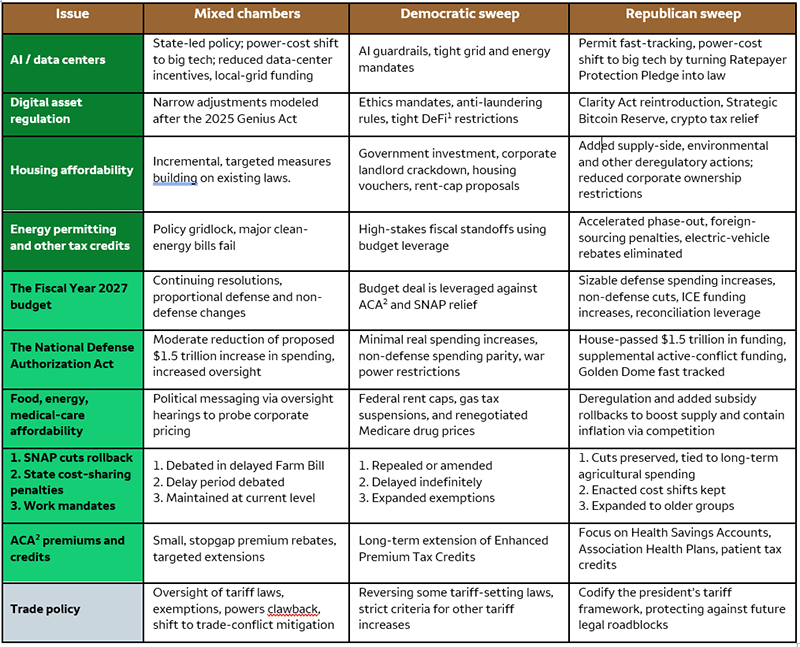
Source: Wells Fargo Investment Institute’s assessment of background accounts of campaign issues, which are arranged in color-coded groups in our view of descending order of visibility to investors, as of October 15, 2026. Note: “Democratic sweep” refers to control of both chambers of Congress. The Surface Transportation Reauthorization Act is less likely to face partisan obstacles but could remain stalled amid broader budget negotiations. 1 Financial services, built on public blockchains, without traditional banking intermediaries. 2 Affordable Care Act (ACA) is in-part healthcare insurance for households in elevated levels of poverty.
Separately, increased use of executive authority is likely to avoid congressional pushback, partly because of legislative inertia and because existing law allows the president control of trade policy (blue shading in the table). Other executive orders likely will focus on tight immigration controls, expanded energy production on federal lands and reduced environmental regulations, accelerated AI integration, tighter control over education, and further changes to public health policies.
Cambridge University Press cites studies showing that a split-government Congress on average has passed about four fewer major laws per two-year term than under a unified government.
1 Source: “The Presidency Project,” University of California at Santa Barbara, October 2, 2026.
2 For more on the deficit, see Richard Rubin, “U.S. Budget Deficit Jumps to Nearly $2 Trillion,” The Wall Street Journal, October 8, 2026.
The midterms more a game changer for policy than for the economic outlook
The likelihood of divided government with narrow voting margins implies that congressional control alone is likely to keep upward pressure on borrowing costs but otherwise have limited influence on the broader economic outlook. Here, we consider what each outcome could mean for U.S. economic growth, inflation, interest rates, and the U.S. dollar.
U.S. economic growth
We expect AI-related investment, labor-market conditions, consumer resilience, energy prices, and Federal Reserve (Fed) policy to remain the primary growth drivers through 2027. Congressional control could influence regulation and spending, but our outlook for U.S. economic growth remains unchanged across all three election scenarios. This would be consistent with history: Table 2 illustrates that government configuration has not correlated with a meaningful difference in average economic growth since 1979. Over that period, two-year inflation-adjusted gross domestic product (GDP) growth has averaged roughly the same pace under divided congressional chambers and single-party control, suggesting that the business cycle and broader economic conditions have mattered more for growth than the configuration of political control.
| Congressional configuration |
Number of Congresses since 1979 |
Average two-year real GDP growth* |
| Single-party control |
7 |
5.33% |
| Divided chambers |
16 |
5.41% |
| All Congresses |
23 |
5.39% |
Sources: Wells Fargo Investment Institute; Copilot; Bureau of Economic Analysis; St. Louis Federal Reserve Economic Data (FRED); History, Art, & Archives, Party Divisions of the House of Representatives, 1789 to Present, and United States Senate Parties & Leadership. Single-party control = one party controls the House, Senate, and presidency. Divided government = any other configuration, including the 2001 – 2002 Congress when Senate control changed during the term. Sample begins with the 96th Congress in 1979 – 1980 and ends with the 118th Congress in 2023 – 2024. *Two-year real GDP growth is cumulative, inflation-adjusted economic growth from the fourth quarter immediately before a new Congress is seated through the fourth quarter of its second calendar year.
To reiterate, the high likelihood of inter- and intra-party disagreements is likely to deliver targeted discretionary spending increases, in our view, but overall nondiscretionary spending on Social Security, Medicare, and Medicaid seem set to drive a wider deficit once more. The net public-sector impact on growth is likely to be modest. From the private sector side, we still expect business technology spending to grow strongly, even if consumer spending slows under higher borrowing costs. The net effect is likely to be an economy that slows modestly in 2027 but avoids recession or deeper downturn.
Inflation
We expect 12-month topline Consumer Price Index inflation to end 2027 at 3.0%, slowing only modestly from our year-end 2026 forecast of 3.6%. Even as we expect global energy-supply disruptions to ease as next year progresses, AI input-cost pressures, modest rental reinflation, and a resilient economy should sustain inflation above the Fed’s target of 2.0%. We think it unlikely that Congress will limit the president’s tariff authorities, but any tariff reduction could temper some inflation pressures while efforts to slow deregulation might raise costs in certain industries like financials, health care, energy, and technology.
Continued Republican control might present the greatest upside inflation risk if additional tax cuts, tariffs, or tighter immigration policies were to stimulate demand or constrain labor supply. But faster energy permitting and greater domestic energy production might offset some cost pressures in this scenario.
Interest rates
We expect the postelection path of interest rates to follow the path of a modestly growing economy and inflation that eases as 2027 develops. In addition, fixed-income markets will be watching how Congress and the president work out the federal budgets for 2027 and 2028 over the coming 15 months.
Divided government can constrain major legislation, and budget and debt-ceiling negotiations could also require compromises that increase spending or delay fiscal restraint. As a result, markets likely will focus less on legislative gridlock itself and more on whether fiscal negotiations ultimately add to Treasury borrowing needs, keeping longer-term yields elevated across scenarios. Based on our forecast of modest growth and cooling inflation, we expect the 10-year Treasury note yield to finish 2027 between 5.25% – 5.75%.
However, policy has a dual role to play. We expect the Fed to address inflation by raising short-term interest rates by a full percentage point over the coming year. Budget negotiations are also important. The previous article laid out possible federal budget deficit paths under the three election outcome scenarios. As inflation, heavy Treasury issuance, and ongoing private borrowing to finance technology investment continue, we expect longer-term yields to remain elevated and thereby increase mortgage, auto-, and student-loan rates.
The U.S. dollar’s exchange value
We believe U.S. economic growth, inflation, interest rates, and budget deficits will matter more for the U.S. dollar than the election result alone. A more hawkish Fed and elevated Treasury yields should support modest dollar appreciation through 2027. We believe relatively favorable U.S. growth prospects will also continue to attract domestic and foreign demand for U.S. assets regardless of which party controls Congress. Election outcomes could affect the currency at the margin through fiscal and trade policy, but relative growth, inflation, interest-rate differentials, and budget deficits should remain the dominant drivers.
Policy matters more for selected industries than broader sectors or the economic outlook
Continued Republican control could support investment through tax and regulatory policy while increasing inflation and borrowing risks. Split or Democratic control would make major legislation less likely and leave regulators, agencies, courts, and fiscal negotiations to shape policy more incrementally. These differences may create selective opportunities and periods of volatility without materially changing the broader economic outlook. We believe that the election outcome will matter more for fiscal policy, government-debt service, and selected industries than for the overall economic outlook. We next consider specific investment opportunities.
Of the 34 Congresses since 1960, only three coincided with a federal budget surplus.
Source: U.S. Office of Management and Budget via Federal Reserve Bank of St. Louis (FRED).
Outcomes may shift opportunities, but durable economic trends anchor our guidance
Midterm elections can create uncertainty as investors consider how a change in congressional control may affect taxes, spending, and regulation. We believe the outcome could meaningfully affect certain sectors and industries. However, broader market performance is likely to remain driven primarily by economic growth, corporate earnings, inflation, interest rates, and long-term investment trends. That distinction is central to our portfolio guidance.
Potential asset class implications from election outcomes:
- Equities: Policy changes related to health-care subsidies, housing affordability, energy, AI, and data-center investment could have greater impact on the relative performance of specific sectors rather than altering the direction of the broader market.
Defense appropriations, renewable-energy incentives, and digital-asset regulation could vary across scenarios, but powerful secular trends are likely to dictate the broader market direction. In particular, we believe ongoing AI investment and rising data-center demand will remain more important drivers of performance, and we specifically favor the Industrials, Communications Services, and Materials sectors for this exposure. Within Industrials, Aerospace & Defense may remain among the most sensitive industries to election outcomes and budget timing, although we think recent valuation declines may already reflect some investor concern about a slow appropriations process.
We believe that the sectors to avoid are just as important to keep in mind. Consumer Staples makes this list because we believe we see resilient economic growth and comparatively better opportunities in our favored sectors, which are part of the technology-related investment trends. Our other unfavorable equity sector is Real Estate, which we believe will continue to lag the composite S&P 500 Index because of persistently elevated long-term borrowing costs.
- Fixed income: Democratic efforts to reverse Medicaid and ACA cuts could reinstate subsidies and help selected municipal issuers, especially state obligations in health care and education, where federal funding cuts have been a risk. Meanwhile, persistent deficits and heavy Treasury issuance to fund policy goals could keep long-term yields volatile regardless of control of government. Among investment-grade securities, we reiterate our preference for U.S. Short Term Taxable Fixed Income.
- Commodities: Policy differences on electric-vehicle tax incentives, energy permitting, AI, data-center development, and trade policy could have commodity implications. Initiatives aiming to accelerate data-center and electrical-grid investment will likely drive stronger demand for energy and industrial metals. While permitting and alternative energy policies could influence the pace of supply growth.•
- Digital assets: Congressional control could influence the timing and direction of regulation. Potential outcomes range from incremental changes to existing legislation to more comprehensive legislation such as the Clarity Act, which aims to provide greater regulatory clarity for the broader digital-asset industry.
Take political views to the polls, not to the portfolios
We do not favor positioning portfolios around a single political outcome. To reiterate, divided government — both between and within parties — is likely to block sweeping policy changes. We do expect post-election fiscal policy developments to impact markets through increased Treasury issuance and thereby impact more the potential opportunities around particular sectors sensitive to interest rates.
To this point, fiscal policy could have longer-lasting market effects through borrowing costs, but we think it worth remembering that divided government has not determined the direction of federal borrowing. As Chart 1 demonstrates, the rising federal deficit and expanding borrowing needs have persisted across Republican, Democratic, and split control of Congress. While the specific policy goals of each party may differ, they all generally have resulted in more borrowing, either through increasing spending or cutting taxes. Over roughly the past 30 years, disagreements have centered on how money should be spent, not whether it should be spent at all.
Chart 1. Federal deficits have persisted under varied congressional control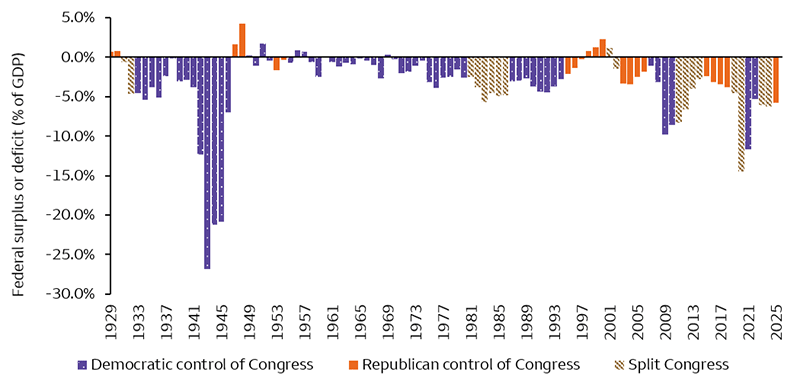
Source: Federal Reserve Bank of St. Louis (FRED) as of December 31, 2025. Control of government is based on Congress and does not consider the party of the president. A budget surplus means federal government revenues are higher than expenditures. A deficit means expenditures are greater than revenues. GDP = gross domestic product.
Elections matter, but they are only one of many forces affecting markets. Our guidance is designed to participate in current technology trends, including U.S. earnings growth and AI-related investment, while using shorter-maturity bonds and commodities to help manage interest-rate, inflation, and geopolitical risks. The election may change which sectors lead, but we do not believe it changes the value of a disciplined, diversified approach. Rather than speculating on the election result or making short-term trades in rapidly changing industries, we favor a diversified portfolio positioned for the durable trends shaping markets.
“Since 1949, equity returns in midterm years have averaged 4.6%, compared with 11.3% in non-midterm years.”
Source: U.S. Midterms: Limited Change Now, Greater Policy Risks Ahead”, State Street Investment Management, September 14, 2026.