


May 2026
Global Fixed Income Strategy Team
Q&A — Addressing concerns about rising U.S. federal debt
Key takeaways
- Congressional Budget Office (CBO) projections for federal debt present a challenge to Congress and the president, today and in the coming decades, but we do not view the challenge as insurmountable.
- The U.S. Treasury market remains the largest and most liquid in the world, and we anticipate no imminent change to the importance of the U.S. Treasury market to global investors.
What it may mean for investors
- We continue to anticipate strong global demand for U.S. Treasuries and favor considering them as part of a long-term portfolio allocation.
In this Q&A report, we address some key questions we are hearing from investors around the fiscal health of the U.S. government and what implications fiscal challenges may have on investors. But first we highlight some key data points1 from the Treasury Department and estimated projections from the CBO:
- Current average rate the U.S. government pays to finance the debt: 3.32%.
- Over half of U.S. debt owned by the public (more than $15 trillion) will mature in the next 3 years.
- Most likely this debt will need to be refinanced. If so, at current interest rate levels —somewhere between 3.75% – 5.25% — it would cost an additional $300 billion to service the debt.
- Annual deficits are estimated to run between $1.8 – $2.0 trillion over the next three years.
- Assuming the three-year deficit is covered by issuing more debt, this will add another $5 – $6 trillion to the already more than $30 trillion debt owned by the public.
- Over three years, this will also add $200 – $250 billion in annual interest expense.
- In our view, U.S. finances require adjustments to spending and revenue. Procrastination by Congress is likely to make the ultimate adjustments larger and more dramatic.
1. Why are there different ways to measure debt (total debt, debt held by the public, public debt-to-GDP, etc.) Which is the best measure for investors?
Many economic or financial indicators can be measured in different ways, each with their own specific uses. Therefore, it isn’t a question of which is “best” rather a question of which way is applicable to investors. Our preference is generally for measures of “debt held by the public” as a percent of the value of the U.S. economy’s annual output, Gross Domestic Product (GDP). This measure includes debt owned by U.S. investors (the Federal Reserve and depository institutions, state and local governments, private investors, etc.) and foreign official and private investors, but excludes debt held by Social Security and other federal trusts accounts. We prefer this measure of debt because we view it as the most applicable to the debt load that may impact investors. Finally, we prefer to express debt as a share of the economy’s size, because most often, a larger economy may be better prepared to service larger amounts of debt.
2. Why is there so much concern about the U.S. fiscal health?
The federal government’s debt as a ratio to GDP is projected by the CBO to reach 101% in 2026, its highest level since the end of World War II. Without action from Congress, the CBO estimates the ratio could increase toward 175% over the next 30 years.2 These projections present a challenge to Congress and the president, today and in the coming decades, but we see options available to the federal government and do not view the challenge as insurmountable.
The U.S. government will have to choose some combination of higher taxes and lower spending to reduce the large and rising deficits implicit in the CBO’s projections. As overall debt levels and interest expenses grow, the U.S. government will likely see net interest costs consume a larger percentage of GDP and likely would weigh on economic growth. Fortunately, there is history for just such adjustments and reason to expect adjustments, as we describe below. We believe this is an important point to remember, and the remaining questions below explore both the challenge and the opportunity before Congress.
3. Is there a risk of U.S. Treasury default or the Federal Reserve (Fed) “printing money” to pay off the debt?
The United States issues debt in its own currency, has a broad tax base, and currently possesses the legal and institutional capacity to service its obligations. While debt‑ceiling episodes historically have created short‑term political risk and market volatility, past congressional debt standoffs have reflected political negotiations—not an inability to pay—and Congress has thus far acted to avoid an outright default. (The US. has experienced rare technical payment delays—most notably in 1979 due to operational issues—but these were limited in scope, quickly resolved). We believe it is important to separate default risk from fiscal sustainability concerns. Rising debt levels raise legitimate long‑term questions about budget priorities, but those concerns are fundamentally different from the risk of missed interest or principal payments, which would require a deliberate political decision rather than a financial constraint.
The Fed, in our view, would not “print money” to pay government debt. The Fed is legally prohibited from directly financing government spending, and its policy tools are aimed at achieving inflation and employment goals—not funding deficits. Using monetary policy to finance debt could undermine Fed independence, damage confidence in the U.S. dollar, and ultimately push borrowing costs higher. History suggests that growing fiscal pressures have been ultimately addressed through a combination of slower spending growth, higher revenues, and stronger economic growth—outcomes that we believe are far more likely than either default or debt monetization.
4. What does history suggest about how federal debt has been reduced, and how long might it take to come down from current debt levels?
The math is clear. The U.S. government spends more money than it collects. Hence, it must issue more and more debt to cover the deficit. The obvious way to help reduce the debt is to reduce the amount of spending, or to increase taxes to pay down the debt. Other schools of thought believe that the U.S. could increase productivity and economic growth (similar to what occurred after World War II) and keep a more stable public debt/GDP ratio.
In our view, it is unrealistic to believe the government will aim to reduce the debt outright; its goal most likely will be to manage it in a way in which debt grows (the deficit) at a slower pace than the economy by implementing a target range of public debt/GDP ratio. To this point, there is some similarity to a private household with a loan. Even if the amount of a loan may be large, the bank lender may approve a loan if the size of the loan is reasonable relative to the borrower assets and if the monthly payment is an acceptable ratio to monthly income per the lender. If Congress adopted such sound debt management practices, it would help maintain the U.S. Treasury’s credibility with investors.
Fortunately, there have been historical precedents for action by Congress and the president. Forty years ago, the U.S. federal debt servicing cost rose sharply, and rising interest costs squeezed the budget. Chart 1 illustrates the increase and the slew of laws passed to control the budget’s expansion.
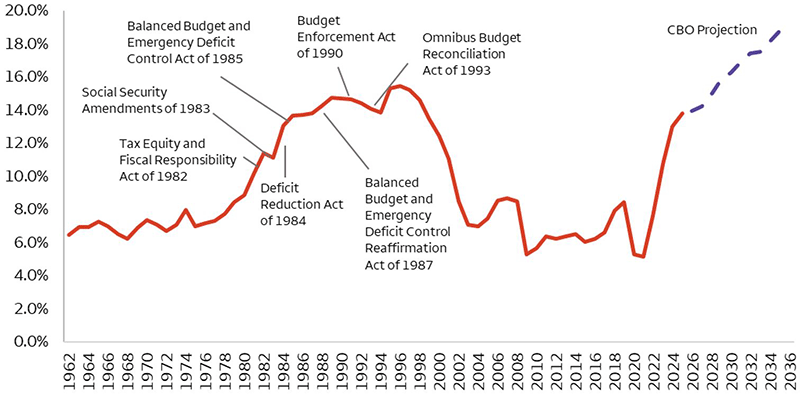 Sources: “The Budget and Economic Outlook: 2026 to 2036,” Congressional Budget Office, February 2026 and Wells Fargo Investment Institute, May 5, 2026. Projections are not guaranteed and are based on certain assumptions and views of market and economic conditions which are subject to change.
We are not seeing that inclination yet in Congress, but the budget’s share of interest payments is already as high as in those earlier periods. The challenge is likely to grow approaching 2032, when Social Security and Medicare will require additional funding. In our view, the longer Congress waits to address the rising share of interest payments, the more investors demanding austerity are likely to push yields higher. In turn, higher yields should put downward pressure on economic growth and, likely limit the ability of congressional members to secure new discretionary spending for their districts. Either way, members of Congress may see their approval ratings fall. As deficits widen and squeeze discretionary programs further, we may see approval ratings fall enough to incentivize change.
What Chart 1 does not show is that the public debt/GDP ratio declined in the aftermath of these measures, and with a strong tailwind from technology-driven economic growth. The period from 1994 – 2001 shaved nearly 20 percentage points from the public debt/GDP ratio. A smaller reduction in the ratio occurred between 2005 – 2007. This could serve as a guide to our current lawmakers on how to start dealing with this issue.
Our conclusion is that today, as 40 years ago, falling congressional approval ratings are likely one incentive to rationalize the budget, but that today, as 40 years ago, those political decisions may be easier, now that greater economic efficiencies are giving workers and company owners more income. What happened 40 years ago may be setting up again.
5. Why then aren’t financial markets pricing much concern over this path currently?
If the U.S. remains on its current spending path, at some point financial markets could begin to press the Treasury for a higher premium (higher rates) to hold U.S. debt, especially those bonds with longer maturities. This would likely make long-term yields increase to higher levels than they otherwise would. But for now, in theory, as long as the economy grows faster than the deficit, demand for U.S. Treasury debt should remain healthy. Recent Treasury auctions have been well received, another example of why there is no immediate pressure on politicians to act. Long-term U.S. Treasury yields increased during March and April of 2026, but we believe this has been more a result of increasing inflation expectations due to rising energy prices than to faltering confidence in the financial status of the U.S., especially since the U.S. dollar has also strengthened during this period.
6. I own U.S. Treasury securities inside my portfolio — How concerned should I be?
For perspective, we should remember that the U.S. Treasury market is the largest and most liquid in the world and is roughly the size of the other major tradable markets combined. Investors who look outside the U.S. Treasury market will find smaller markets, where the smaller number of buyers and sellers means that a large transaction could move prices for all in that market. By comparison, the sheer size and liquidity of the U.S. Treasury market gives U.S. and foreign investors greater reason to expect price stability. We believe these are the major reasons dollar-denominated securities remain the largest share of any global government security in the reserves of other countries. There simply are no good substitutes for U.S. Treasury securities, and we expect this to remain the case.
We believe an imminent crisis is very unlikely. Yields on Treasury securities have been higher than they were a decade ago but have been well within historical ranges. The U.S. has the world’s largest and arguably most dynamic economy, the world's most frequently used currency for international investment, and a strong military. Taken together, we believe that the size and strength of the U.S. economy, and the liquidity and yield provided by the Treasury market, make U.S. Treasury securities the largest share of the reserves that foreign governments hold — and support the U.S. dollar as the world’s principal currency for reserves and for global transactions.3
7. Could the Fed manage monetary policy in a way that it influences interest rates lower to help ease the debt burden?
The Fed’s goal is not to keep interest rates low just to ease the cost of financing the debt. By law, the Fed must try to support economic growth by managing the target fed funds rate and unemployment levels in line with its statutory goals. The Fed is not responsible for proper fiscal management; however, its interest-rate policies do affect debt issuance. Fed independence remains crucial in order to prevent monetary policy decisions from political influence. In our view, if this trust in Fed independence were to be breached it would cause Treasury yields to move higher and further complicate the cost of financing the debt.
Also, in our opinion, the risk is that interest rates will stay at higher levels for longer than we saw from the financial crisis through the pandemic, when short-term interest rates were near zero percent for many years and 10-year U.S. Treasury maturities experienced rates under 3% for a significant period. Furthermore, the threat of higher inflation or even sticky inflation above the Fed’s target likely places a near-term floor on short-term rates. Many Fed officials consider the current fed funds target range of 3.50-3.75% (as of May 5, 2026) as being relatively close to neutral, that is, a level that allows the U.S. economy to operate close to full employment and under stable inflation. At this time, the range of outcomes appears to be skewed towards rates moving higher from current levels. Higher interest rates generally make servicing the outstanding debt more burdensome for taxpayers.
8. Moving forward, could the debt ceiling help limit debt issuance?
In July 2025, the One Big Beautiful Bill Act (OBBBA) raised the debt ceiling by $5T from $36.1T to $41.1T. Since 1960, Congress has acted 78 separate times to raise, extend, or revise the definition of the debt limit4. The current debt ceiling is expected to be reached in late-2026, and once it is reached, the Treasury will be unable to increase the amount of debt outstanding — unless Congress passes another bill raising the debt ceiling. However, the Treasury is still able to use a series of extraordinary measures to conserve resources and avoid default, typically for many months after the congressional deadline.
The debt ceiling does not directly impact federal spending and the Treasury cannot issue debt to cover spending that Congress has not previously authorized. The debt ceiling deadlines have been used for political posturing in the past. While the political parties may use the deadline as a means to extract political spending concessions, in practice neither party wants to be responsible for defaulting on the U.S. debt. Given Congress’ history of raising or extending the debt ceiling, we believe it is unlikely that this by itself will limit debt issuance for long. Legislative uncertainty over raising the debt ceiling has at times brought about market uncertainty and rating agency downgrades.
9. What happened to the revenue the government was supposed to raise from tariffs? Does the loss of tariff revenue increase the risk of debt going higher?
While some estimates for the OBBBA show the act adding more than $4 trillion to the deficit between 2025 and 2034, the Trump Administration argued that planned tariffs would counterbalance this.5 With the Supreme Court’s repeal of the International Emergency Economic Powers Act (IEEPA) tariffs in February 2026, more than 70% of tariff revenue for 2025 was ordered to be refunded to tariff payers, although the actual refund process likely will take many months. Tariff revenue increased by more than 150% in 2025, largely on the back of IEEPA, and the Committee for a Responsible Federal Budget estimates that the repeal of IEEPA tariffs will eliminate more than $1T in revenue over the next decade. There was little impact on long-term Treasury yields immediately following the repeal of the IEEPA tariffs, and we believe this stems from market expectations for new revenue streams under the alternative tariffs. However, it is still difficult to estimate how much tariff revenue may add to federal revenue. Perhaps more importantly, as households, businesses and foreign companies adjust their purchases to avoid tariffs in the coming years, the federal tariff revenue could peak and then decline sharply, as we saw after the 2018 tariffs. Bottom line: it is hard to expect tariff revenue to eliminate deficits going forward.
Investment implications
In sum, while we believe the CBO’s debt growth projections point to unsustainable growth in the public debt/GDP ratio over the coming decades, the trajectory can change. Congress has historically considered austerity measures to reduce the public debt/GDP ratio as the interest burden rises. As well, the political necessity for some corrective measures can even encourage a faster-growing economy and, in turn, a more sustainable fiscal path. That political will seems to be lacking currently, so, on balance, we believe there is a higher-for-longer pressure on overall interest rate levels, absent an economic crisis or recession from other sources.
Taking a broader perspective, our investment guidance generally includes an allocation to U.S. Treasuries in an effort to preserve and grow wealth. We believe U.S. Treasury securities remain important for domestic and international investors, but uncertainty remains about how much and how quickly Congress can adjust its budgets. That risk can still be part of an investors consideration that weighs risks and rewards across financial markets and types of instruments.
Portfolio diversification is a foundational principle that allows investors the flexibility to adjust to dynamic risks and potential rewards. For example, a diversified portfolio that seeks to reduce the risk of fiscal crisis may adjust the types and maturities of fixed-income securities and may include assets such as European equities and bonds, and real assets such as real estate, infrastructure, and gold. An investment professional can help investors identify their goals and risk tolerance and find an appropriate diversification strategy.
1 “Debt Position and Activity Report,” TreasuryDirect.gov, March 31, 2026. “The Budget and Economic Outlook: 2026 to 2036,” Congressional Budget Office, February 2026. Wells Fargo Investment Institute, May 5, 2026.
2 “The Budget and Economic Outlook: 2026 to 2036.” www.cbo.gov/publication/62105.
3 Please see our special report, “The U.S. dollar’s future as an international currency”, Wells Fargo Investment Institute, May 29, 2025.
4 As per the U.S. Department of the Treasury.
5 See our Policy, Politics, and Portfolios reports from August 2025 and March 2026 for further discussion of the impact of the OBBBA and tariff policy on the deficit.
Risks Considerations
Different investments offer different levels of potential return and market risk. The level of risk associated with a particular investment or asset class generally correlates with the level of return the investment or asset class might achieve. Stock markets are volatile. Stock values may fluctuate in response to general economic and market conditions, the prospects of individual companies, and industry sectors. Foreign investing has additional risks including those associated with currency fluctuation, political and economic instability, and different accounting standards. These risks are heightened in emerging markets. Bonds are subject to market, interest rate, price, credit/default, liquidity, inflation, and other risks. Prices tend to be inversely affected by changes in interest rates. Although Treasuries are considered free from credit risk, they are subject to other types of risks. These risks include interest rate risk, which may cause the underlying value of the bond to fluctuate. Investing in gold or other precious metals involves special risk considerations such as severe price fluctuations and adverse economic and regulatory developments affecting the sector or industry. Investments in infrastructure companies expose an investment to potentially adverse economic, regulatory, political, and other changes affecting such companies. Real estate has special risks including the possible illiquidity of underlying properties, credit risk, interest rate fluctuations and the impact of varied economic conditions.
General Disclosures
Global Investment Strategy (GIS) is a division of Wells Fargo Investment Institute, Inc. (WFII). WFII is a registered investment adviser and wholly owned subsidiary of Wells Fargo Bank, N.A., a bank affiliate of Wells Fargo & Company.
The information in this report was prepared by Global Investment Strategy. Opinions represent GIS’ opinion as of the date of this report and are for general information purposes only and are not intended to predict or guarantee the future performance of any individual security, market sector or the markets generally. GIS does not undertake to advise you of any change in its opinions or the information contained in this report. Wells Fargo & Company affiliates may issue reports or have opinions that are inconsistent with, and reach different conclusions from, this report.
The information contained herein constitutes general information and is not directed to, designed for, or individually tailored to, any particular investor or potential investor. This report is not intended to be a client-specific suitability or best interest analysis or recommendation, an offer to participate in any investment, or a recommendation to buy, hold or sell securities. Do not use this report as the sole basis for investment decisions. Do not select an asset class or investment product based on performance alone. Consider all relevant information, including your existing portfolio, investment objectives, risk tolerance, liquidity needs and investment time horizon. The material contained herein has been prepared from sources and data we believe to be reliable but we make no guarantee to its accuracy or completeness.
Wells Fargo Advisors is registered with the U.S. Securities and Exchange Commission and the Financial Industry Regulatory Authority, but is not licensed or registered with any financial services regulatory authority outside of the U.S. Non-U.S. residents who maintain U.S.-based financial services account(s) with Wells Fargo Advisors may not be afforded certain protections conferred by legislation and regulations in their country of residence in respect of any investments, investment transactions or communications made with Wells Fargo Advisors.
Wells Fargo Advisors is a trade name used by Wells Fargo Clearing Services, LLC and Wells Fargo Advisors Financial Network, LLC, Members SIPC, separate registered broker-dealers and non-bank affiliates of Wells Fargo & Company.