



September 15, 2026
Paul Christopher, CFA, Head of Global Investment Strategy
When market worries will not stop at three
Key takeaways
- Investors are dealing with several uncertainties that have focused attention on inflation and bond yields.
- These issues may not resolve quickly and may create volatile price movements while they linger.
What it may mean for investors
- Our focus is not about eliminating uncertainty, but about making portfolio choices so that uncertainty can work in the investor’s favor.
- Our current guidance does not ignore the issues but focuses on the specific opportunities we see in them.
People look for patterns in events, and there’s the proverb, “bad things happen in threes,” to make sense of a stressful week or a series of unexpected mishaps. Likewise, a sequence of events can make investors worry. But instead of pretending that worries will just go away, we would rather take perspective from the broader investing environment. We see a disciplined approach as best, whether life’s worries come in threes, or more.
Four issues now on investors’ minds
The U.S.-Canada tariff exchanges1: For perspective, last year public announcements of large tariffs yielded to private negotiations and lower tariffs. That door remains open. The U.S. is making the automobile tariffs effective January 1, 2027, and other provisions have a three-week window before becoming effective.2 But tariffs are taxes that raise prices, so some inflationary impact is reasonable, unless and until the signs of a deal emerge.
Higher crude oil and refined product prices: Escalating U.S.-Iran attacks since August 28 signal to us sharp, new economic pressure on both sides. The global benchmark European Brent crude oil cash price rose from $89.71/barrel on August 27 to $120.28/barrel on September 10, the largest two-week gain since the first two weeks of the war (March 2-15). Meanwhile, Reuters and other sources confirm that Iran’s oil at sea and available to sell to its main customer, China, is only about five months-worth at China’s current purchase rate.3 We also expect the latest U.S. sanctions to shut off Iran’s inflow of oil revenue from Iran’s other customers.4 We do not know whether the U.S. or Iran will cave first, and further escalations are possible, but we believe the pressure to reopen the Strait is intensifying in proportion to the rapidly growing economic stress.
The Federal Reserve (Fed) and short-term interest rates: As of August 19, interest rate futures market pricing implied a 31% probability that the Fed will raise its target short-term interest rate (and, by extension, the prime rate) by a quarter-point at its September 16 policy meeting. But new tariffs and sharply higher energy prices since mid-August threaten rising inflation and helped lift that implied probability to 88% by September 11. The debate is shifting toward whether policymakers can afford to ignore new inflation shocks from energy and tariffs.
Private bond issuance: Goldman Sachs and JPMorgan estimate artificial intelligence (AI) -related 10-year corporate debt issuance between $300 billion and $320 billion, year-to-date through August, and their 2027 estimates are even higher.5 The 2026 estimates are roughly 68% of new, long-term Treasury issuance and 40% of total (including rollover debt) issuance through August. AI bonds are competing with U.S. Treasury debt for investor cash.6
What the headlines miss about these issues
Uncertain inflation impacts from the war and the tariffs, questions about how much borrowing costs may rise, and concerns about the flood of bond issuance have triggered higher yields. The U.S. Treasury’s program to buy back some of its 10-, 20- and 30-year debt has inserted a large buyer into those markets, and the extra cash or liquidity from buybacks can help restrain yields but has not reversed their rise.
Higher yields have prompted headlines to speculate that investors are refusing to buy U.S. Treasury securities. We do see growing pressure for Congress to rationalize its budget, but we think the headlines that link rising yields to an imminent government debt crisis consistently exaggerate the risk. Notably, the September 9 U.S. 10-year Treasury note auction bid-to-cover of 2.71 showed that the number of investor bids were nearly three times the debt being offered, the strongest since 2019.
International evidence also refutes the claim that investors are especially negative on U.S. Treasury securities. The top panel in the chart on the next page confirms that U.S. 10-year Treasury yield and comparable government bond yields for the largest three European Union economies (Germany, France, and Italy) have all risen in the past year, especially since the Iran war began on February 28. We also note from the bottom panel that the average of the European yields has risen by more than the U.S. yield since early July, likely reflecting the comparatively greater inflation risk to Europe from higher energy prices. These patterns suggest that global inflation risk is driving global bond yields, not that investors are particularly negative on U.S. Treasury securities.
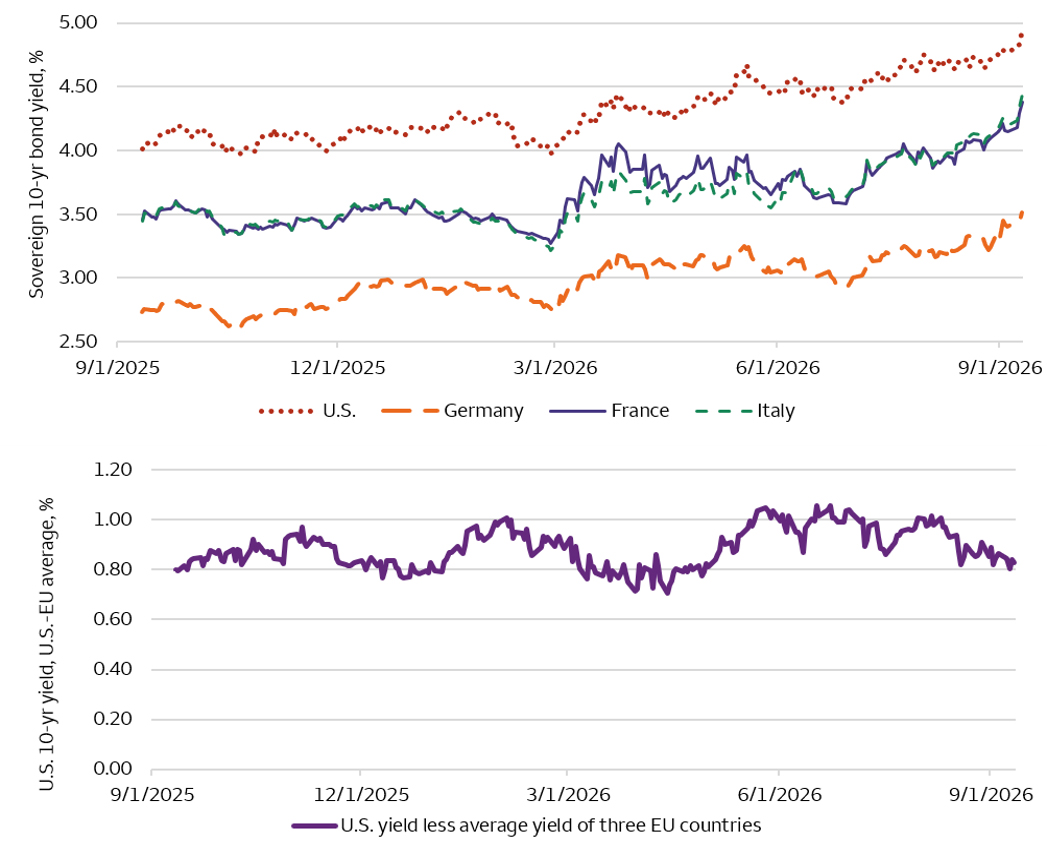 Sources: U.S. Treasury, Deutsche Bundesbank, Bloomberg, and Wells Fargo Investment Institute. Daily data, September 1, 2025 – September 11, 2026. Data are for the 10-year active sovereign bonds of the U.S., Germany, France, and Italy. Yr = year. EU = European Union.
Some U.S. historical perspective also may help. The recent rise in U.S. bond yields looks high relative to average yields during the 2009-2021 period. Our recent report, “Can AI help pay America’s bills?”, highlights today’s economic similarities to the period of 1840 to 1890, when new railroads first crisscrossed the U.S. and helped power the fastest 50-year income per capita growth rate in U.S. history — so far.7 Private bond markets raised the capital needed to build the railroads. In fact, the historical data show a 12-fold increase in private debt issuance between 1867-1890.8 Today’s surge in private debt is significant enough to compete with the U.S. Treasury for funds and contributes to higher Treasury yields, but we believe tomorrow’s benefit from AI and other technologies could strengthen private income and federal revenue growth and potentially bring the future closer to that earlier and singular period of income growth.
Our perspective on approaching capital markets right now
This time, the bundle of issues may come, not as three, but as four or maybe even five, once investors start thinking seriously about the midterm elections. Market reactions to uncertainties are always with us, and may lead market prices higher or lower, but the discipline in investing is to distinguish between destructive and productive volatility.
To this point, it is worth reiterating this passage from our September 14 “State of the Markets” essay:
The irony is that great investing can feel boring for long stretches of time. Yet beneath that apparent calm is a continuous exercise in judgment, discipline, and resilience. Our view is that you should stay invested, stay patient, and keep exposure and concentration disciplined. In investing, you do not need to be right all the time. You simply need to be in the game when it matters most.
An area we think matters quite a lot right now is U.S. Large Cap Equities. Strong earnings and a resilient economy have lifted equity markets into mid-September and confirm our 2026 outlook for the S&P 500 Index (the Index) of large companies to advance this year more on earnings growth than from making stocks more expensive. The second-quarter Index earnings season has posted 34% growth. Eighty-six percent of companies have beaten expectations. Earnings surprises topped 60% in every sector and were above 80% in nine. We expect the Index to post 28.5% 12-month earnings for the third quarter, for a third straight quarter above 25%.
This focus is a large part of the portfolio preferences that we reiterate here, in closing:
- Look through near-term volatility. We continue to favor equities over fixed income, supported by resilient corporate earnings and healthy profit growth. We continue to maintain the unfavorable view on long-maturity fixed income since March 2025.
- Keep fixed income short. We prefer directing new fixed-income allocations toward investment-grade maturities of two years or less, where investors are being paid attractively without assuming significant duration (a measure of a bond’s interest rate sensitivity) risk. We reiterate our neutral rating on Information Technology fixed income.
- Maintain an overweight to Information Technology. Strong earnings momentum and sustained AI-related demand remain powerful tailwinds. Communication Services and Materials offer attractive complementary exposure to the broader AI investment ecosystem, often at more reasonable valuations.
- Favor large-cap U.S. equities. We prefer large caps over mid- and small-cap stocks given stronger earnings profiles, greater balance-sheet quality, and more attractive risk-adjusted opportunities. We remain neutral on international and emerging market equities despite a weaker U.S. dollar.
- Maintain an overweight to precious metals, particularly gold. Geopolitical uncertainty and elevated policy risks still support the strategic case for holding portfolio insurance that does not require quarterly earnings calls.
1 For details, please see Barbara Weisel, “The Fallout of the U.S.–Canada Trade War,” Carnegie Endowment for International Peace, September 10, 2026.
2 “Trump’s Targeted Canada Tariffs Offer Scope and Time for a Deal,” Bloomberg News, September 10, 2026.
3 See “What does a U.S. naval blockade of Iran mean for oil flows,” Reuters, April 13, 2026; and D. Khatinoglu, “Iran crude loadings plunge to one-seventh of pre-war level as blockade bites, Iran International,” August 21, 2026.
4 The United Arab Emirates (UAE) and China are the two main financial intermediaries that transfer revenue to Iran from its customers. Recent Iranian missile strikes on the UAE lead us to believe the Emiratis will be unwilling to continue this role.
5 “How AI debt is reshaping credit markets,” Goldman Sachs, August 5, 2026; and AJ Tiarsmith, “AI Companies’ Debt Now Equals 68% of New Long-Term U.S. Treasury, Yahoo finance,” September 10, 2026.
6 Ibid.
7 See Louis Johnston and Samuel H. Williamson, "What Was the U.S. GDP Then?", MeasuringWorth. U.S. Bureau of Economic Analysis data 1929-present linked to Johnston-Williamson estimates for 1790-1928.
8 We start that calculation in 1867 to avoid disruptions due to the Civil War. Data Source: U.S. Department of the Census, Historical Statistics of the United States, 1789-1945, Chapter K, sections 18-27.
Risks Considerations
Each asset class has its own risk and return characteristics. The level of risk associated with a particular investment or asset class generally correlates with the level of return the investment or asset class might achieve. Stock markets, especially foreign markets, are volatile. Stock values may fluctuate in response to general economic and market conditions, the prospects of individual companies, and industry sectors. Foreign investing has additional risks including those associated with currency fluctuation, political and economic instability, and different accounting standards. These risks are heightened in emerging markets. Small- and mid-cap stocks are generally more volatile, subject to greater risks and are less liquid than large company stocks. Bonds are subject to market, interest rate, price, credit/default, liquidity, inflation and other risks. Prices tend to be inversely affected by changes in interest rates. Although Treasuries are considered free from credit risk they are subject to other types of risks. These risks include interest rate risk, which may cause the underlying value of the bond to fluctuate. Sovereign debt is generally a riskier investment when it comes from a developing country and tends to be a less risky investment when it comes from a developed country. The stability of the issuing government is an important factor to consider, when assessing the risk of investing in sovereign debt, and sovereign credit ratings help investors weigh this risk. The commodities markets are considered speculative, carry substantial risks, and have experienced periods of extreme volatility. Investing in a volatile and uncertain commodities market may cause a portfolio to rapidly increase or decrease in value which may result in greater share price volatility. Investments in gold and gold-related investments tend to be more volatile than investments in traditional equity or debt securities. Such investments increase their vulnerability to international economic, monetary and political developments.
Sector investing can be more volatile than investments that are broadly diversified over numerous sectors of the economy and will increase a portfolio’s vulnerability to any single economic, political, or regulatory development affecting the sector. This can result in greater price volatility. Communication Services companies are vulnerable to their products and services becoming outdated because of technological advancement and the innovation of competitors. Companies in the Communication Services sector may also be affected by rapid technology changes, pricing competition, large equipment upgrades, substantial capital requirements and government regulation and approval of products and services. Materials industries can be significantly affected by the volatility of commodity prices, the exchange rate between foreign currency and the dollar, export/import concerns, worldwide competition, procurement and manufacturing and cost containment issues. Risks associated with the Technology sector include increased competition from domestic and international companies, unexpected changes in demand, regulatory actions, technical problems with key products, and the departure of key members of management. Technology and Internet-related stocks, especially smaller, less-seasoned companies, tend to be more volatile than the overall market.
An index is unmanaged and not available for direct investment.
General Disclosures
Global Investment Strategy (GIS) is a division of Wells Fargo Investment Institute, Inc. (WFII). WFII is a registered investment adviser and wholly owned subsidiary of Wells Fargo Bank, N.A., a bank affiliate of Wells Fargo & Company.
The information in this report was prepared by Global Investment Strategy. Opinions represent GIS’ opinion as of the date of this report and are for general information purposes only and are not intended to predict or guarantee the future performance of any individual security, market sector or the markets generally. GIS does not undertake to advise you of any change in its opinions or the information contained in this report. Wells Fargo & Company affiliates may issue reports or have opinions that are inconsistent with, and reach different conclusions from, this report.
The information contained herein constitutes general information and is not directed to, designed for, or individually tailored to, any particular investor or potential investor. This report is not intended to be a client-specific suitability or best interest analysis or recommendation, an offer to participate in any investment, or a recommendation to buy, hold or sell securities. Do not use this report as the sole basis for investment decisions. Do not select an asset class or investment product based on performance alone. Consider all relevant information, including your existing portfolio, investment objectives, risk tolerance, liquidity needs and investment time horizon. The material contained herein has been prepared from sources and data we believe to be reliable but we make no guarantee to its accuracy or completeness.
Wells Fargo Advisors is registered with the U.S. Securities and Exchange Commission and the Financial Industry Regulatory Authority, but is not licensed or registered with any financial services regulatory authority outside of the U.S. Non-U.S. residents who maintain U.S.-based financial services account(s) with Wells Fargo Advisors may not be afforded certain protections conferred by legislation and regulations in their country of residence in respect of any investments, investment transactions or communications made with Wells Fargo Advisors.
Wells Fargo Advisors is a trade name used by Wells Fargo Clearing Services, LLC and Wells Fargo Advisors Financial Network, LLC, Members SIPC, separate registered broker-dealers and non-bank affiliates of Wells Fargo & Company