



April 1, 2026
Brian Rehling, CFA
Head of Global Fixed Income Strategy
Mason Mendez
Investment Strategy Analyst
Custody of digital assets — What investors need to know
Key takeaways
- Digital-asset custody involves the storage and management of private keys that grant ownership access to cryptocurrencies, non-fungible tokens (NFTs), stablecoins, and other blockchain-based assets.
- Custody of digital assets typically falls into three categories: self-custody, partial or hybrid custody, and third-party custody.
What it may mean for investors
- Understanding the basics of custody is crucial for those investing in digital assets as it impacts security, ease of use, and exposure to risks.
- Wells Fargo clients can gain indirect exposure to digital assets through exchange-traded funds (ETFs). These ETFs often involve third-party custody managed by qualified providers.
Digital-asset custody involves the secure storage and management of private keys that grant ownership access to cryptocurrencies1, NFTs2, stablecoins3, and other blockchain-based assets. Unlike traditional assets such as stocks that rely on centralized records or physical documents, digital assets depend entirely on these cryptographic keys4. They are typically long cryptographically generated non-resettable strings of letters and numbers, much like passwords. It is important to note that if the keys are lost, stolen, or compromised, the assets may be permanently inaccessible.5
Grasping the basics of custody when investing in digital assets is essential as it affects security, ease of use, and exposure to risks. As digital assets become more mainstream, investors should carefully consider custody options and the benefits of professional oversight. Wells Fargo clients can gain indirect exposure to digital assets through exchange-traded funds (ETFs). These ETFs often involve third-party custody managed by qualified providers.6 Therefore, ETFs provide exposure to digital assets with a more traditional investing approach, while eliminating the need for direct key management, which would otherwise be needed if an investor were to directly own the native coin (digital asset). However, this report covers the three primary types of custody to ensure that investors are fully informed.
Types of custody
Custody for digital assets generally falls into three main categories: self-custody, partial or hybrid custody, and third-party custody. Each type differs in terms of who controls the keys, the level of security provided, and the complexity involved.
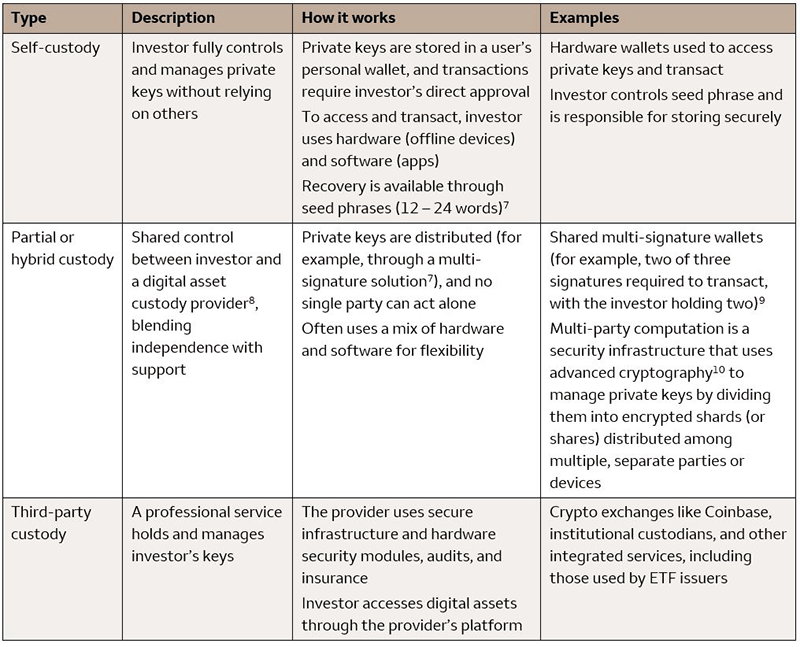
| Type | Description | How it works | Examples |
|---|---|---|---|
| Self-custody | Investor fully controls and manages private keys without relying on others | Private keys are stored in a user’s personal wallet, and transactions require investor’s direct approval To access and transact, investor uses hardware (offline devices) and software (apps) Recovery is available through seed phrases (12 – 24 words) | Hardware wallets used to access private keys and transact Investor controls seed phrase and is responsible for storing securely |
| Partial or hybrid custody | Shared control between investor and a digital asset custody provider , blending independence with support | Private keys are distributed (for example, through a multi-signature solution7), and no single party can act alone Often uses a mix of hardware and software for flexibility | Shared multi-signature wallets (for example, two of three signatures required to transact, with the investor holding two) Multi-party computation is a security infrastructure that uses advanced cryptography to manage private keys by dividing them into encrypted shards (or shares) distributed among multiple, separate parties or devices |
| Third-party custody | A professional service holds and manages investor’s keys | The provider uses secure infrastructure and hardware security modules, audits, and insurance Investor accesses digital assets through the provider’s platform | Crypto exchanges like Coinbase, institutional custodians, and other integrated services, including those used by ETF issuers |
Characteristics of each type
Self-custody gives users complete autonomy over their assets, ensuring privacy and eliminating the need to rely on external parties, which reduces counterparty risks and often lowers long-term fees. This can appeal to those who want full control and are comfortable with the technical aspects. However, it places the burden on the individual to maintain keys and seed phrases. Losing keys or seed phrases can lead to irreversible loss — some estimates suggest around 20% of bitcoin has been lost this way.11 Self-custody is also susceptible to phishing attacks, malware, or user mistakes.
Partial or hybrid custody seeks to balance ownership by sharing control, which helps mitigate single-point failures through distributed keys and often offers recovery options. This approach combines independence of self-custody with some professional support from the provider’s security and compliance controls, making it an option for users that want involvement but need safeguards. On the downside, setups for hybrid custody options through shared multi-sig wallets or multi-party computation can be more complicated, and there is still an element of trust in the provider. Partial or hybrid custody is not widely available, especially for retail investors, limiting its accessibility.
Third-party custody focuses on prioritizing convenience and professional-grade security, with providers employing robust measures like insurance (in the event of custodian failure, not against market losses), regular audits, and advanced infrastructure in an effort to protect assets.12 Many ETF issuers handle custody of the underlying assets like bitcoin or ether13, allowing clients indirect exposure without managing keys themselves. This option includes customer support and compliance with current regulations. ETFs often include fees, withdrawal restrictions, and the risk of the custodian failing, such as through hacks or bankruptcy.
What you need to know
Currently Wells Fargo Advisor clients interact with digital assets primarily through ETFs, which means indirect custody through the ETF’s third-party arrangements. Investors hold digital assets indirectly, eliminating the need for direct key management, but it still exposes investors to market-price movements (of the underlying digital asset). Even though Wells Fargo clients can only interact with digital assets through spot ETFs, it is important to understand the full range of risks and best practices. Strong personal security such as unique passwords and multi-factor authentication is vital. Private keys or seed phrases should never be shared, and seed phrases should be stored in offline, secure locations. Cyber threats like phishing and malware are prevalent, and regulatory protections are limited. Most blockchains are decentralized, and there can be little recourse if funds are lost or stolen.
Selecting the appropriate custody option for digital assets depends on factors like how much an investor values autonomy and privacy, as well as technical comfort and risk appetite. Investors should benefit from focusing on education, robust security habits, and careful vetting to sidestep pitfalls, whether accessing digital assets through our firm or independently. As regulations and advancements in digital-asset custody continue to develop, ongoing awareness is crucial for effectively managing digital assets.
1 Cryptocurrencies are a form of digital asset primarily used in exchange related functions. For a complete introduction please see our four-part introductory series of reports, “Understanding Digital Assets.”
2 Non-fungible tokens are digital asset tokens that represent the ownership of physical or digital assets that are transferred and stored on blockchains. For a complete introduction please see our report, “Non-fungible tokens (NFTs) — What investors need to know.”
3 Stablecoins are a form of digital assets designed to maintain a relatively stable value and are often linked to a reserve asset. For a complete introduction please see our report, “Stablecoins: An introduction.”
4 Cryptographic keys are randomly generated strings of letters and numbers used to encrypt text. They act as a private password that grants access to a user’s digital wallet.
5 “The future of digital asset custody: building trust at scale,” State Street, July 2025.
6 “The importance of custodians in bitcoin adoption and ownership,” KPMG, September 10, 2024.
7 Seed phrases are 12 – 24 random-word sequences that act as a backup or recovery for digital wallets. They are generated by the digital wallet software and are important safety measure for self-custodied digital assets.
8 Hybrid digital asset custody providers are companies that offer custody services for digital assets. Hybrid custody providers offer custody options that distributes control of private keys between the owner and custodian.
9 Muli-signature (multisig) wallets are digital wallets that require two or more private keys to authorize any transactions.
10 Cryptography is the process of securing information by converting data or text into an unreadable cypher using algorithms.
11 “How many bitcoin are lost,” Ledger, November 19, 2025.
12 “The future of digital asset custody: Building trust at scale,” State Street, July 2025.
13 Ether is the native token on the Ethereum blockchain. The two phrases are commonly used interchangeably, however, prices of the token itself (ether) is what investors buy or sell — not the blockchain.
Risks Considerations
Exchange-traded funds are subject to risks similar to those of stocks. Investment returns may fluctuate and are subject to market volatility, so that an investor’s shares, when redeemed, or sold, may be worth more or less than their original cost. ETFs seek investment results that, before expenses, generally correspond to the price and yield of a particular index. There is no assurance that the price and yield performance of the index can be fully matched.
Virtual or cryptocurrency is not a physical currency, nor is it legal tender. Bitcoin and other cryptocurrencies are a very speculative investment and involves a high degree of risk. Investors must have the financial ability, sophistication/experience and willingness to bear the risks of an investment, and a potential total loss of their investment. An investor could lose all or a substantial portion of his/her investment. Cryptocurrency has limited operating history or performance. Fees and expenses associated with a cryptocurrency investment may be substantial. Cryptocurrencies are sometimes exchanged for U.S. dollars or other currencies around the world, but they are not backed or supported by any government or central bank. Their value is completely derived by market forces of supply and demand, and they are more volatile than traditional fiat currencies.
Definitions
Cryptographic Keys: Cryptographic keys are randomly generated strings of letters and numbers used to encrypt text. They act as a private password that grants access to a user’s digital wallet. There are two types of keys , public keys and private keys. Public keys act as an address for which users can receive digital assets, while private keys act as a password granting access to manage and transact their digital assets.
Digital Wallet/Personal Wallet/Hardware Wallet Digital wallets are software application or physical device that stores cryptographic keys needed to access, and manage a user’s cryptocurrencies stored on their respective blockchains. Digital wallets can be stored online through software applications, or offline using physical storage known as hardware wallets or cold wallets.
Blockchain : Blockchains are decentralized ledgers secured by cryptography that record transactions across a network of computers in a secure and transparent manner. For a complete introduction please see Wells Fargo Investment Institute’s report, “Blockchain technology basics,” November 13, 2025.
General Disclosures
Global Investment Strategy (GIS) is a division of Wells Fargo Investment Institute, Inc. (WFII). WFII is a registered investment adviser and wholly owned subsidiary of Wells Fargo Bank, N.A., a bank affiliate of Wells Fargo & Company.
The information in this report was prepared by Global Investment Strategy. Opinions represent GIS’ opinion as of the date of this report and are for general information purposes only and are not intended to predict or guarantee the future performance of any individual security, market sector or the markets generally. GIS does not undertake to advise you of any change in its opinions or the information contained in this report. Wells Fargo & Company affiliates may issue reports or have opinions that are inconsistent with, and reach different conclusions from, this report.
The information contained herein constitutes general information and is not directed to, designed for, or individually tailored to, any particular investor or potential investor. This report is not intended to be a client-specific suitability or best interest analysis or recommendation, an offer to participate in any investment, or a recommendation to buy, hold or sell securities. Do not use this report as the sole basis for investment decisions. Do not select an asset class or investment product based on performance alone. Consider all relevant information, including your existing portfolio, investment objectives, risk tolerance, liquidity needs and investment time horizon. The material contained herein has been prepared from sources and data we believe to be reliable but we make no guarantee to its accuracy or completeness.
Wells Fargo Advisors is registered with the U.S. Securities and Exchange Commission and the Financial Industry Regulatory Authority, but is not licensed or registered with any financial services regulatory authority outside of the U.S. Non-U.S. residents who maintain U.S.-based financial services account(s) with Wells Fargo Advisors may not be afforded certain protections conferred by legislation and regulations in their country of residence in respect of any investments, investment transactions or communications made with Wells Fargo Advisors.
Wells Fargo Advisors is a trade name used by Wells Fargo Clearing Services, LLC and Wells Fargo Advisors Financial Network, LLC, Members SIPC, separate registered broker-dealers and non-bank affiliates of Wells Fargo & Company.