What affordability policies may mean for markets and investors
Affordability has become one of the defining economic and political issues in the run-up to this year’s midterm elections. Despite a backdrop of still slowing inflation, the cumulative increase in costs since the pandemic continues to weigh on household finances. Lower-income households have borne the brunt of the near-30% rise in prices of essentials that account for a greater share of their budgets than for upper-income households. Higher oil prices during the Middle East conflict risk further intensifying affordability, but our view is for a transitory and limited inflation impact.
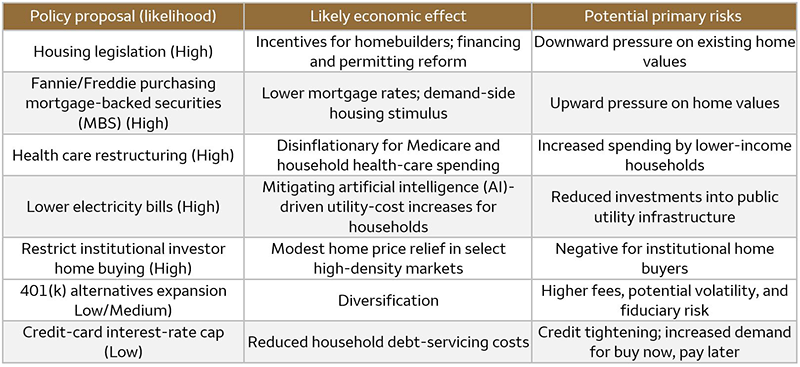
An array of affordability-focused policy proposals have already been introduced ahead of the midterms with more likely in the months ahead. Some ideas, such as a cap on credit-card interest rates, have lost momentum amid industry opposition while others, including proposals to expand 401(k) investments into alternative assets, face significant regulatory hurdles that cloud the timeline for implementation (Table 1). We focus here on those we believe are more likely to be enacted and to have significant market impact.
Table 1. Potential impacts of Trump administration affordability proposals
| Policy proposal (likelihood) |
Likely economic effect |
Potential primary risks |
| Housing legislation (High) |
Incentives for homebuilders; financing and permitting reform |
Downward pressure on existing home values |
| Fannie/Freddie purchasing mortgage-backed securities (MBS) (High) |
Lower mortgage rates; demand side housing stimulus |
Upward pressure on home values |
| Health care restructuring (High) |
Disinflationary for Medicare and household health-care spending |
Increased spending by lower-income households |
| Lower electricity bills (High) |
Mitigating artificial intelligence (AI)-driven utility-cost increases for households |
Reduced investments into public utility infrastructure |
| Restrict institutional investor home buying (High) |
Modest home price relief in select high density markets |
Negative for institutional home buyers |
| 401(k) alternatives expansion Low/Medium) |
Diversification |
Higher fees, potential volatility, and fiduciary risk |
| Credit-card interest-rate cap (Low) |
Reduced household debt servicing costs |
Credit tightening; increased demand for buy now, pay later |
Sources: Wells Fargo Investment Institute and Bloomberg. March 2026.
Policy themes and market impacts
In housing, a number of policy proposals have been introduced with varying prospects for implementation. The administration’s directive for Fannie Mae and Freddie Mac to purchase up to $200 billion in MBS is supporting lower mortgage rates in the near term while bipartisan efforts to expand housing supply and limit institutional-investor demand should help restrain home price increases1. On balance, we see these proposals as net disinflationary. We believe these potential impacts should reinforce currently cooling rental inflation and thereby represent help to affordability through the 30% of the consumer price index represented by housing.
On the health care front, one of the most visible threats to affordability are expiring enhanced Affordable Care Act premium tax credits, estimated to more than double average marketplace premiums for subsidized enrollees.2 A House-passed extension is currently stalled in the Senate. We expect Congress to extend tax credits in some form that could help restrain the increase in household health-care spending for affected enrollees. Meanwhile, we see a partial offset to higher premium costs from negotiated Medicare drug prices this year with estimated out‑of‑pocket savings of $1.5 billion.3 Other proposals, including expanded eligibility for health savings accounts and Pharmacy Benefit Manager reforms, aim to add disinflationary pressure on health-care spending.
Lastly, efforts to contain rising electric bills are becoming a politically salient issue driven by data-center construction and other AI-related infrastructure expansion. AI‑related infrastructure investments are contributing to higher utility costs. In response, regulators are increasingly focused on ratepayer protection by transferring costs to data centers. Specifically, the administration has introduced the Ratepayer Protection Pledge (the Pledge), a voluntary commitment by hyperscalers to fund their own power generation and grid renewals. This proposal should help mitigate potential additional utility costs to households associated with AI. The risk from this proposal is that directing investment in power generation from public utilities to AI data centers could ultimately raise public prices if non-AI power demand increases. We do not see this as an immediate risk, however, and expect that the Pledge and the concurrent development of lower-cost solar and wind capacity throughout 2026 will help restrain utility-rate inflation.4
What it may mean for investors
We expect lower inflation from the combined impact of the affordability policies we see as most likely to be implemented. We believe the proposals in housing, health care, and utilities should support consumer-based economic growth, largely by easing pressure on financially stressed lower-income households.
But as the table above suggests, a number of less-likely policies may be announced. We favor looking through the day-to-day news headlines that may include a stream of similarly unlikely policy headlines in the run-up to the midterm elections. Any new headlines may bring market volatility, and there remains significant uncertainty about the war in Iran. But we do not believe these will derail our constructive economic outlook, and we think it’s important to remember that we believe any transient war-related energy price hikes are unlikely to overshadow the disinflationary trends implied by these policies and at work elsewhere in the economy. In our view, the most important disinflationary trends that are already in place include slowing rental inflation, more gradual U.S. tariff increases, deregulation’s cumulative cost savings, and AI-driven spending and productivity gains. Together, we think these will likely help to counter what we view as a short-term war-related spike in fuel and food costs.
From 2020 to 2022, the Federal Reserve purchased $1.33 trillion in agency MBS, freeing up bank funds to increase mortgage lending and supporting a surge in housing demand amid underlying supply constraints.
Sources: Brookings Institution, October 8, 2025; Federal Reserve Bank of Chicago, September 28, 2023. This information is not intended to predict future Federal Reserve actions, mortgage‑market outcomes, or investment performance.
1 Orbach, Rebecca, Emily Waters, Laura Hausman, and Kyle Klurfield. “Comparing the ROAD to Housing Act and the Housing for the 21st Century Act.” Bipartisan Policy Center, February 6, 2026.
2 Lo, Juliette, Larry Levitt, Jennifer Ortaliza, and Cynthia Cox. “ACA Marketplace Premium Payments Would More Than Double on Average Next Year if Enhanced Premium Tax Credits Expire.” KFF, September 30, 2025.
3 Centers for Medicare & Medicaid Services. “Medicare Drug Price Negotiation Program: Negotiated Prices for Initial Price Applicability Year 2026 | CMS.” August 16, 2024.
4 U.S. Energy Information Administration. “New U.S. Electric Generating Capacity Expected to Reach a Record High in 2026.” February 20, 2026.
The Supreme Court weighs in on tariffs
On February 20, 2026, the Supreme Court rendered its decision overturning a number of President Trump’s “Liberation Day” tariffs. The court found that these tariffs, issued under the International Emergency Economic Powers Act (IEEPA), exceeded the scope of the president’s powers and would need congressional approval as a form of tax. Broad implementation of tariffs resides with Congress with the president having some tariff power under a variety of statutes, all with caveats and limits. The president implemented a temporary, broad 10% tariff which was then amended to 15% immediately after the announcement under a different statue. The repeal of IEEPA does not repeal all U.S. tariffs and does not prevent their future implementation, so the path of tariff policy may be volatile from here.5 Recent developments on tariffs still have not changed our positive view on the economic environment in the balance of the year.
What changed and what might change from here?
The repealed tariffs issued under IEEPA covered a wide range of purposes and targets. The two largest targets were border security and fentanyl tariffs issued against Mexico, China, and Canada and the so-called “Liberation Day” tariffs issued against essentially every U.S. trading partner. These tariffs altogether accounted for roughly three-fourths of tariff revenue. The remaining tariffs unaffected by this decision were:
- Issued under Section 232 of the Tariff Expansion Act
- More limited in scope
- Intended to target issues vital to national security
This includes tariffs on steel, aluminum, and certain computer chips.
The temporary replacements for the IEEPA tariffs are limited to a maximum of 150 days unless extended by Congress and expires on July 24, 2026. The legality of this tariff has also come under legal scrutiny. Section 122 was intended to cover a situation where U.S. payments to other countries are more than our total earnings, and 24 states have already filed a lawsuit alleging that these requirements have not been met. Other statutes may be used from here to impose highly targeted and not broadly applicable tariffs. We believe that the Trump administration likely will use Section 122 as a stop gap for the next 150 days before moving on to other options.
Unanswered questions
The Supreme Court’s decision seems to leave us with more questions than answers — chief amongst them being the timeline and implementation of further tariffs. Given the Trump administration’s previous stance, it seems almost guaranteed these other statutes will be used aggressively and broadly. Many of them will face challenges in court with a questionable timeline for a decision on their legality. Similar for the president’s recently announced Section 122 tariffs. Questions on IEEPA still remain as the government will have to determine how refunds are processed to importers and importers determine how they flow through to customers. Every further tariff decision will likely face similar issues.
Chart 1. Breakdown of 2025 tariff revenue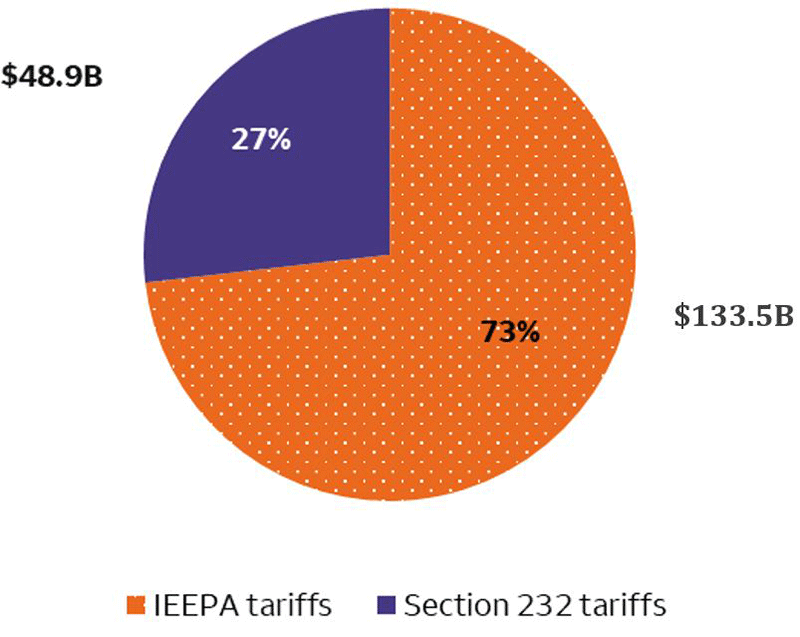
Sources: CBP Trade Statistics as of December 14, 2025. Trade Remedy Duties Assessed through December 14, 2025, in billions.
How might this impact investors?
The word of the day seems to be “uncertainty” when it comes to tariffs. Investors aren’t sure what the impact on the economy will be; the tariff refund process likely will take time; and U.S. trading partners seem unsure how future tariffs will impact existing trade deals. In the near-to-intermediate term, tariff uncertainties and related headlines are likely to result in market volatility. In our view, downside volatility may offer an opportunity to consider allocating funds into equities given our positive economic outlook, which we do not feel will be derailed by volatility in tariff policy. We expect to see above-average economic growth in 2026 with moderate inflation. Consumer spending may benefit from tax rebates contained in the One Big Beautiful Bill Act, which also contained benefits for business, and AI and related infrastructure should help drive earnings beyond 2026. Considering these factors on top of our expectation for continued deregulation may provide a significant tailwind for consumers and the economy. We believe this is the kind of environment that favors risk assets, particularly cyclically sensitive equity sectors like Financials and Industrials whose earnings benefit from improved growth. We encourage investors to maintain a diversified portfolio and use potential volatility as an opportunity to gain further exposure to the growing economy that we see ahead.
Tariff revenue increased more than 150% in fiscal year 2025, largely due to tariffs that have now been overturned.
Repeal of tariffs could eliminate more than $1 trillion in revenue over the next decade.
Source: Committee for a Responsible Federal Budget, October 27, 2025. “Tariff Revenue Soars in FY 2025 Amid Legal Uncertainty”
5 For more detail, see our Institute Alert, "Mapping out the path of tariffs," March 5, 2026.
The U.S. federal budget in 2026 is on target to broaden fiscal deficits
The U.S. federal government is funded every year through a legislative process established in the Budget and Accounting Act of 1921 and the Congressional Budget and Impoundment Control Act of 1974. At a high level, the president proposes a budget, Congress sets spending targets, each legislative chamber’s appropriation committee writes the budget into funding bills, the House and Senate pass their separate versions, then Congress reconciles the differences and votes on a unified bill. Finally, the president can either veto the bill or sign it into law. If the funding deadline is missed, Congress can either pass a continuing resolution to fund the government using prior-year allotments or the government undergoes a partial or full shutdown.
For the 2026 fiscal year, 12 federal funding bills were passed out of committee in September of 2025 and 11 have been passed into law. Three omnibus bills were used to fund most of the federal agencies, but the remaining bill that supports the funding for the Department of Homeland Security (DHS) has failed to reconcile between both chambers ahead of the two-week Easter congressional recess. A limited DHS stopgap funding bill was included within the February 3, 2026, omnibus bill passed but has since expired, leaving the DHS shut down.
Widening U.S. budget deficit
On February 11, the CBO released its annual budget and economic outlook, its first comprehensive update since January 2025. A summary of the major projections regarding the budget deficit over the next 10 years shows the following:
- Annual budget deficit. The federal budget deficit in fiscal year 2026 is $1.9 trillion and grows to $3.1 trillion by 2036. For perspective, the annual deficit briefly touched $3 trillion during the COVID pandemic.
- Deficit as a percentage of GDP. Relative to the size of the economy, the deficit is 5.8% of GDP in 2026 and grows to 6.7% in 2036, significantly higher than the 3.8% deficits averaged over the last 50 years.
- Debt held by the public. Debt held by the public is expected to surpass 100% of GDP this year and is projected to exceed 120% by fiscal year 2036. The previous record of total debt to GDP was 106% reached in 1946 following World War II.
The bottom line is that the U.S. budget deficit is widening and the CBO expects it to increase to record levels. Federal receipts are in line with averages while spending has increased, creating a sustained federal deficit that’s led to a higher percentage of total expenditures allotted to net interest as shown in Chart 2. Net interest to GDP is expected to rise from 3.3% to 4.6% by 2036 while net interest to federal spending is projected to increase from 14% to 19% over the same period. The CBO cites rising net interest costs as the main factor expected to drive record deficits. Major entitlements such as Social Security, Medicare, and Medicaid costs will continue to have a major impact, driving mandatory spending to 15% of GDP by fiscal year 2036.
Chart 2. U.S. federal government functional spend as a percentage of federal tax receipts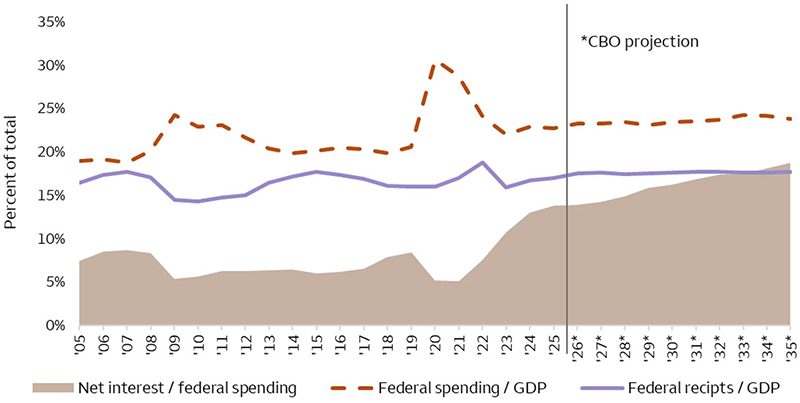
Sources: CBO February 11, 2026, Federal Reserve Bank of St. Louis March 17, 2026, U.S. Treasury March 17, 2026. CBO forecasts are subject to change at any time.
What it means for investors
The prospect of a steeper yield curve is one of the factors behind our most favorable rating on the equity Financials sector. Our fixed-income guidance considers additional factors. The Treasury’s current practice of issuing a higher proportion of Treasury bills (with maturities of one year or less) versus bonds lowers the supply of longer-dated debt, which should support higher prices and lower long-term bonds. At the same time, our economic outlook remains positive, which should help increase long-term yields as some fixed-income investors potentially switch to equities. Long-term yields are also likely to rise further under the uncertainty of the war in Iran as investors try to weigh the impacts of both larger government war spending commitments and the potential for a temporary bulge in inflation. Taken together, our view is that long-term yields are likely to remain volatile this year. With our expected view of increased volatility and the prospect of firmer inflation in the near term,, we are unfavorable on long-term fixed income and prefer either to reduce maturity to intermediate (three to seven years) or consider an overweight allocation toward U.S. Large Cap Equities.
Eleven of the 12 appropriations bills for fiscal 2026 are enacted through the end of fiscal 2026 after two shutdowns
Source: Bloomberg Government. February 23, 2026. “FY 2026 Appropriations Work Nearly Complete.”
Debt held by the public is expected to surpass 100% of GDP this year and exceed 120% by fiscal year 2036, versus the previous record of 106% reached in 1946.
Source: CBO February 11, 2026. “The Budget and Economic Outlook: 2026 – 2036”