



April 6, 2026
Paul Christopher, CFA, Head of Global Investment Strategy
Michelle Wan, CFA, Global Investment Strategist
Iran war update: Global impacts as U.S. deploys new assets
“Our adversary right now thinks there are 15 different ways we could come at them with boots on the ground. And guess what? There are.” — U.S. Secretary of Defense Pete Hegseth, as quoted by the Associated Press, March 31, 2026
end call outKey takeaways
- War escalation risk remains high into the next few weeks. Oil prices spilling into higher transportation and fertilizer prices heighten the economic challenges for global economies that rely on energy imports.
- Global central banks face pressure of tightening liquidity and interest rate hikes to combat inflation. Both forces could slow the pace of expected global economic growth.
What it may mean for investors
- Traditional hedging strategies of investing in gold, U.S. Treasuries, defensive equity sectors, and even a perceived global safe haven like the Swiss franc have not proven effective so far during this conflict.
- We continue to expect a war of limited duration and favor rebalancing in a diversified portfolio, but the main risk is a longer engagement that damages the global economy and undermines financial markets.
Key events in the war during the week of March 28 - April 6, 2026
Throughout last week: Comments by President Donald J. Trump and Iranian officials on diplomacy contrasted with ongoing strikes by both countries and their allies, as well as with reported new U.S. military deployments to the Middle East, including ground troops. However, there were no reports that strikes had destroyed or disabled energy infrastructure. Markets remained on edge, posting days of both strong risk appetite and strong risk avoidance.
March 28 – 29: The New York Times reported that Yemen’s Houthis had fired ballistic missile launches at Israel.
March 30: Multiple U.S. news outlets, including Fox News and CNBC reported that President Trump denied interest in a ceasefire and that he called for the Strait of Hormuz (the Strait) to be policed by other nations, not the U.S.
March 31: The Associated Press reported that the U.S. Central Command (CENTCOM) had confirmed the deployment of elements of the U.S. 82nd Airborne Division to the Middle East. CBS reported Defense Secretary Pete Hegseth remarks that “upcoming days will be decisive” and that the U.S. was in talks with allies to reopen the Strait.
April 1: President Trump addressed the nation, saying that the U.S. is near achieving its core strategic objectives in the war with Iran and that actions will be taken in the coming weeks to finish the job. The Wall Street Journal reported that the United Arab Emirates had announced plans to join the military effort to reopen the Strait.
April 2: The Agence France-Presse reported Iran’s Khatam al-Anbiya announcement of a new wave of missile and drone attacks. Bloomberg news reported that Iran and Oman are drafting a protocol to oversee navigation through the Strait.
April 3-4: CBS News reported that Pakistan confirmed its role to broker a ceasefire. Mixed messages came out of Iran including one suggesting a deadlock in the mediation efforts as reported by The Associated Press.
April 6: Reuters reported that President Trump has extended the deadline for Iran to accept a deal to April 7.
Market reactions so far in the war (March 28 –through April 4)
The week of March 28 –– April 4 intensified the diplomatic divergence between the U.S. and Iran. As the week closed for global financial and commodity markets, investors once again found themselves off balance as President Trump’s April 7 deadline for Iran to make a deal approaches.
As they did during the week of March 23 – 27, financial and commodity markets seemed to adopt a day-by-day focus on the competing prospects for more violence or a diplomatic solution to the crisis. The U.S. S&P 500 Index rallied by nearly 3.5% for the week ended April 2, including an intraday swing of 125 basis points (2%) intraday on April 2. Notably, April 2 news about a possible Iran-Oman protocol to navigate the Strait sparked that intraday recovery that extended beyond the S&P 500 Index to include the Nasdaq Index and the Dow Jones Industrials Index, which all rose modestly for the week. The news also helped suppress the April 2 gain in oil prices and the U.S. dollar, moderated the day’s loss in gold’s price, and pushed the U.S. 10-year Treasury note yield lower.
We caution that considerable unease appears to permeate market sentiment. Options markets continue to provide useful signals about the inherent uncertainty across markets at present. In our view, the salient feature of the U.S. West Texas Intermediate crude oil options contracts since March 2 has been the market’s ongoing push for a higher and later peak in oil prices. Three weeks ago, our report noted the strongest open interest (number of option contracts) and strongest daily buying on March 13 at $90 per barrel for crude oil for delivery in June. Our March 23 report saw the peak price (again, based on open interest and daily volume) between $95 and $100.1 As of April 2, the peak interest and volume focused on the June contract but is now firmly at $120.2
Global economic consequences — so far
International comparisons continue to favor the U.S. since the war began on February 28. From March 2 – April 2, the S&P 500 Index outperformed both the MSCI Emerging Markets Index and the MSCI Europe, Australasia, and the Far East Index of developed ex-U.S. equities. The ICE U.S. Dollar Index appreciated by nearly 2.5%.3
These market movements suggest to us a comparatively more difficult economic challenge facing the rest of the world, particularly the manufacturing centers in Europe and East Asia. Global economic consequences begin with higher energy and fertilizer prices and filter into the global supply chain with follow-on inflation. By one estimate, 30% of the world’s fertilizer passes through the Persian Gulf.4 Even if U.S. and allied forces hit hard to reopen the Strait in the next 2-3 weeks, the risk of relatively higher inflation overseas should persist, while repairs take place in the Persian Gulf and crop price inflation may take a full growing season to manifest. Thus, we expect a significant inflation increase globally into year-end 2026.
Global central banks face multifaceted pressures. Higher energy prices have begun to cascade into central banks’ balance sheets and liquidity needs. Since the beginning of the year, foreign central banks Treasury bonds held at the U.S. Federal Reserve (Fed) have dropped sharply as central banks needed funds to raise liquidity (Chart 1).
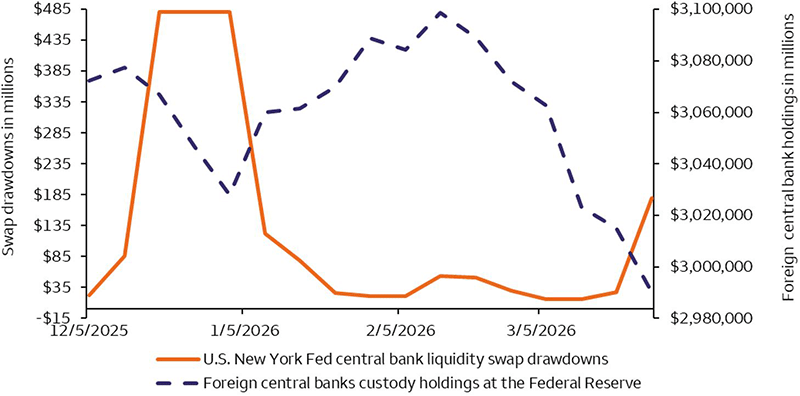 Sources: Wells Fargo Investment Institute, Bloomberg, and St. Louis Federal Reserve. Weekly data as of March 27, 2026. Past performance is no guarantee of future results.
Besides these liquidity vehicles, we have also observed global central banks tapping into their gold reserve as a source of liquidity. Bloomberg reported that the central bank of Turkey sold and swapped about 60 tons of gold worth $8 billion, some sold outright and mostly to secure foreign exchange. The Polish central bank chief has also laid out plans to potentially sell gold to raise about $13 billion to finance defense spending, according to Bloomberg. Both countries were among the largest buyers of gold during 2025, according to data from the World Gold Council. The strained liquidity situation due to higher energy cost and higher dollar led central banks to tap all available sources, which helps demystify why gold was not rising during a major global conflict.
Securing liquidity only partially solves global central banks short-term problems. They also face higher inflation expectations, leaving them potentially compelled to raise interest rates as most central banks face a single mandate of managing inflation. Short-term interest rate futures markets now expect the European Central Bank to hike rates by three-quarters of a percentage point by year-end 2026. For the U.K., expectations are trending in a similar direction — the market expects two hikes by year end. Japanese short-rate market expectations had priced in Bank of Japan rate hikes even before the war started. The longer that oil prices stay high, the more pressure we expect to see on central banks to generate liquidity for their economies and financial markets. If, in addition, policy makers raise interest rates, they could deliver another headwind to their manufacturing-oriented economies.
What should investors do now?
We expect intensified fighting, potentially involving U.S. ground troops. To achieve the goal of destroying the viability of Iran’s regime, the U.S. and Israel may strike more heavily at Iran’s economic infrastructure and may attempt to break Iran’s control over the Strait of Hormuz. Whatever combination of these goals the next two or three weeks unveils, there is room for Iran to escalate in its retaliation. The risk to the other economies of the Persian Gulf may grow.
Traditional hedging strategies in gold, U.S. Treasuries, defensive equity sectors, and even a perceived global safe haven like the Swiss franc have not proven effective while oil prices rise but tactics and diplomacy adjust in sometimes unpredictable ways. We view diversification and rebalancing as a more comprehensive risk management strategy that does not attempt to guess the next adjustment or shock. But staying diversified historically has required some attention to rebalancing. This basic process involves selling assets whose prices appear to have outrun their fundamentals and reallocating the proceeds to cheaper looking assets whose fundamentals look solid. Our tactical guidance has employed this approach several times since 2023 around the ups and downs in technology-related sectors.
We emphasize that considerable volatility could still arise, depending on how Iran and the U.S. prosecute the next phase of the war. We do not see an opportunity to predict a bottom in equity or bond markets, and options markets continue to point to uncertainty about how high oil prices may ultimately go. In this context, we believe the best course for long-term investors is to take limited steps to rebalance. In fixed income, we would focus on investment-grade maturities between 3-7 years. More generally, we favor rebalancing from the Energy commodity sector into the Precious and Industrial Metals sectors and, in the S&P 500 Index sectors, from Energy toward some combination of Financials, Industrials, and Utilities. Investors may also consider restoring a market-weight allocation to the Information Technology equity sector. We continue to favor U.S. equities over international equities.
1 Wells Fargo Investment Institute, “Iran war update: Don’t extrapolate,” March 23, 2026.
2 Wells Fargo Investment Institute, “Iran war update: The challenge of diplomacy during war,” March 30, 2026.
3 The ICE U.S. Dollar Index is a weighted average of the value of the U.S. dollar relative to a basket of U.S. trade partner currencies, composed of the euro, Japanese yen, pound sterling, Canadian dollar, Swedish krona, and Swiss franc.
4 Raj Patel, iPES Food, “The Persian Gulf oil crisis is a food crisis,” March 18, 2026.
Risks Considerations
This commentary is for general informational purposes only, is not individualized investment advice, and should not be used as the sole basis for an investment decision. Views reflect conditions as of April 6, 2026 and may change.
Diversification cannot eliminate the risk of fluctuating prices and uncertain returns and does not guarantee profit or protect against loss in declining markets.
Each asset class has its own risk and return characteristics. The level of risk associated with a particular investment or asset class generally correlates with the level of return the investment or asset class might achieve. Stock markets, especially foreign markets, are volatile. Stock values may fluctuate in response to general economic and market conditions, the prospects of individual companies, and industry sectors. Foreign investing has additional risks including those associated with currency fluctuation, political and economic instability, and different accounting standards. These risks are heightened in emerging markets. Bonds are subject to market, interest rate, price, credit/default, liquidity, inflation, and other risks. Prices tend to be inversely affected by changes in interest rates. Although Treasuries are considered free from credit risk they are subject to other types of risks. These risks include interest rate risk, which may cause the underlying value of the bond to fluctuate. The commodities markets are considered speculative, carry substantial risks, and have experienced periods of extreme volatility. Investing in a volatile and uncertain commodities market may cause a portfolio to rapidly increase or decrease in value which may result in greater share price volatility. Investing in gold or other precious metals involves special risk considerations such as severe price fluctuations and adverse economic and regulatory developments affecting the sector or industry. The use of options involves investment strategies and risks different from those associated with ordinary portfolio securities transactions. There can be no guarantee that the use of options will increase the portfolio’s return or income.
Sector investing can be more volatile than investments that are broadly diversified over numerous sectors of the economy and will increase a portfolio’s vulnerability to any single economic, political, or regulatory development affecting the sector. This can result in greater price volatility. The Energy sector may be adversely affected by changes in worldwide energy prices, exploration, production spending, government regulation, and changes in exchange rates, depletion of natural resources, and risks that arise from extreme weather conditions. Investing in the Financial services companies will subject an investment to adverse economic or regulatory occurrences affecting the sector. There is increased risk investing in the Industrials sector. The industries within the sector can be significantly affected by general market and economic conditions, competition, technological innovation, legislation and government regulations, among other things, all of which can significantly affect a portfolio’s performance. Risks associated with the Technology sector include increased competition from domestic and international companies, unexpected changes in demand, regulatory actions, technical problems with key products, and the departure of key members of management. Technology and Internet-related stocks, especially smaller, less-seasoned companies, tend to be more volatile than the overall market. Utilities are sensitive to changes in interest rates, and the securities within the sector can be volatile and may underperform in a slow economy.
Definitions
ICE U.S. Dollar Index is a weighted average of the value of the U.S. dollar relative to a basket of U.S. trade partner currencies, composed of the euro, Japanese yen, pound sterling, Canadian dollar, Swedish krona, and Swiss franc. A higher index value indicates dollar appreciation.
MSCI Australia Index is designed to measure the performance of the large and mid-cap segments of the Australia market.
MSCI Emerging Markets Index is a free float-adjusted market capitalization index that tracks the performance of large and mid-cap stocks in 24 emerging market countries. The index captures approximately 85% of the free float-adjusted market capitalization in each country.
MSCI Europe Index is a free float-adjusted market capitalization index that is designed to measure developed market equity performance in Europe. The index covers approximately 85% of the free float-adjusted market capitalization across the European Developed Markets equity universe.
MSCI Far East Index captures large and mid cap representation across 3 Developed Markets (DM) countries*. With 221 constituents, the index covers approximately 85% of the free float-adjusted market capitalization in each country.
S&P 500 Index is a market capitalization-weighted index composed of 500 widely held common stocks that is generally considered representative of the US stock market.
An index is unmanaged and not available for direct investment.
Investment Grade bonds - A rating that indicates that a municipal or corporate bond has a relatively low risk of default. Bond rating firms, such as Standard & Poor's, use different designations consisting of upper- and lower-case letters 'A' and 'B' to identify a bond's credit quality rating. 'AAA' and 'AA' (high credit quality) and 'A' and 'BBB' (medium credit quality) are considered investment grade. Credit ratings for bonds below these designations ('BB', 'B', 'CCC', etc.) are considered low credit quality, and are commonly referred to as "junk bonds".
General Disclosures
Global Investment Strategy (GIS) is a division of Wells Fargo Investment Institute, Inc. (WFII). WFII is a registered investment adviser and wholly owned subsidiary of Wells Fargo Bank, N.A., a bank affiliate of Wells Fargo & Company.
The information in this report was prepared by Global Investment Strategy. Opinions represent GIS’ opinion as of the date of this report and are for general information purposes only and are not intended to predict or guarantee the future performance of any individual security, market sector or the markets generally. GIS does not undertake to advise you of any change in its opinions or the information contained in this report. Wells Fargo & Company affiliates may issue reports or have opinions that are inconsistent with, and reach different conclusions from, this report.
The information contained herein constitutes general information and is not directed to, designed for, or individually tailored to, any particular investor or potential investor. This report is not intended to be a client-specific suitability or best interest analysis or recommendation, an offer to participate in any investment, or a recommendation to buy, hold or sell securities. Do not use this report as the sole basis for investment decisions. Do not select an asset class or investment product based on performance alone. Consider all relevant information, including your existing portfolio, investment objectives, risk tolerance, liquidity needs and investment time horizon. The material contained herein has been prepared from sources and data we believe to be reliable but we make no guarantee to its accuracy or completeness.
Wells Fargo Advisors is registered with the U.S. Securities and Exchange Commission and the Financial Industry Regulatory Authority, but is not licensed or registered with any financial services regulatory authority outside of the U.S. Non-U.S. residents who maintain U.S.-based financial services account(s) with Wells Fargo Advisors may not be afforded certain protections conferred by legislation and regulations in their country of residence in respect of any investments, investment transactions or communications made with Wells Fargo Advisors.
Wells Fargo Advisors is a trade name used by Wells Fargo Clearing Services, LLC and Wells Fargo Advisors Financial Network, LLC, Members SIPC, separate registered broker-dealers and non-bank affiliates of Wells Fargo & Company.