



March 23, 2026
Paul Christopher, CFA
Head of Global Investment Strategy
Iran War update: don’t extrapolate
Key takeaways
- The Iran War last week continued to heighten concerns about its duration and economic impact.
- The sequence of escalations by both sides has developed as we have been expecting, albeit at a faster pace that suggests both sides are facing growing constraints that may prevent a long conflict.
What it may mean for investors
- Market movements continue to support energy equities and commodities, and the U.S. dollar over gold, but the S&P 500 Index is starting to struggle against international benchmarks. Yields are higher, but not only on inflation concerns.
- The main risk is a longer engagement that damages the global economy and undermines financial markets. We continue to expect a short war and favor rebalancing in a diversified portfolio.
Key events in the war during the week of March 16-22, 2026
Throughout the week: Israel and the U.S. further reduced Iran’s missile and drone resources. Israel continued to push Hezbollah (a proxy army of Iran) out of southern Lebanon. Reports of Iranian attacks on the Gulf states continued.
March 16: U.S. News reported that President Trump called for seven countries (naming specifically China, France, Japan, South Korea, the UK) to help open and secure tanker passage through the Strait of Hormuz. There were no takers.
March 17: Multiple news channels reported a U.S. Central Command (CENTCOM, the U.S. Department of Defense combat command for the Middle East and South/Central Asia) statement that U.S. forces had employed 5,000-pound deep penetrator munitions on hardened Iranian missile sites along Iran’s coastline near the Strait of Hormuz, citing the risk to navigation from Iranian anti-ship missiles.1
March 18: Bloomberg News reported Iran’s claim that Israel had struck Iran’s giant South Pars natural gas field and sparked a fire. In the same report, Iran claimed responsibility for a retaliatory attack on Qatar’s Ras Laffan Industrial City natural gas facility that caused extensive damage.
On the same day, following the South Pars attack, Reuters quoted President Trump as saying Israel would not make any more attacks on Iranian facilities in South Pars unless Iran attacked Qatar, warning that the U.S. would attack those facilities if Iran acted against Doha.
The Federal Reserve (Fed) held the federal funds target rate range at 3.50%-3.75%. At his press conference, Fed Chairman Powell noted that the conflict in Iran poses uncertain implications for U.S. economic data.
March 20: Brent crude oil futures for delivery in May closed at $106.41, the highest price level for nearby Brent futures since July 7, 2022, just after Russia invaded Ukraine.
March 21: The U.K. Telegraph reported a statement by U.S. Treasury Secretary Scott Bessent that for 30 days the U.S. will allow purchases of Iranian oil that is stranded at sea.
The Wall Street Journal and CNN reported that the U.S. will deploy between 2,200-2,500 additional Marines from the California-based USS Boxer Amphibious Ready Group and 11th Marine Expeditionary Unit.
Iran launched two ballistic missiles at the United Kingdom’s air base on Diego Garcia Island (part of the Chagos Archipelago in the central Indian Ocean, roughly 2,500 miles from Iran), from which the U.S. has been launching long-range bombers against Iran. The missiles fell short of the target but signal a long-range Iranian capability.
Market reactions so far in the war (March 2 through March 20)
For capital market movements last week, crude oil prices remained the focus and accelerated over the pace of the previous week. The exchange of attacks on natural gas infrastructure on March 18 was the likely driver. Benchmark Brent crude oil futures for delivery in May rose by 3.53% on March 18, the largest single-day percentage increase last week. Chart 1 shows the Brent-West Texas Intermediate (WTI) price gap diverging last week, as Brent pushed ahead.
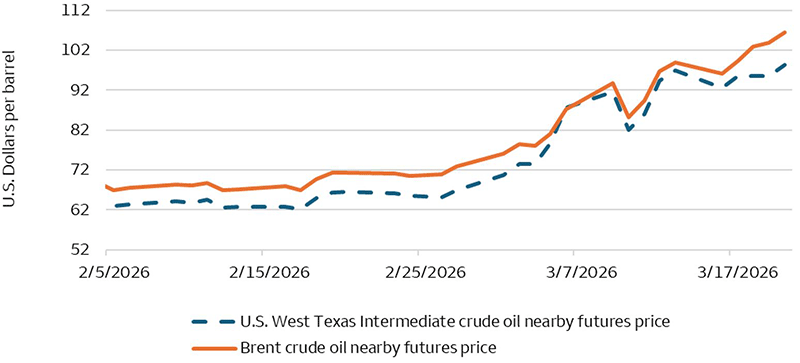 Source: Bloomberg and Wells Fargo Investment Institute. Daily data, February 5, 2026 – March 20, 2026. The prices shown are for futures contracts (May delivery) of Brent and West Texas Intermediate crude oil.
This divergence may be part of the growing preoccupation with the possible duration of the conflict. Sensitivity to this topic among U.S. officials appears to be growing. President Trump’s March 16 call for help escorting tankers through the Strait of Hormuz, CENTCOM’s March 17 announcement of heavy bombs used to destroy anti-ship missiles along the Strait, and the March 21 U.S. decision to allow purchases of Iranian oil stranded at sea since the war began strongly suggest intensified U.S. political and military attention to the surge in oil prices.
Evidence from equity and currency markets suggests that investor impatience may be focusing more on the wait for U.S. initiatives to reopen the Strait of Hormuz. Even though the U.S. seems to have an advantage over other regions (especially Asia) as an energy exporter, the S&P 500 Index roughly declined in line with the MSCI Emerging Markets Index and the MSCI EAFE Index between March 6 and March 20. Also, the ICE U.S. Dollar Index (against a basket of six major currencies) slid between March 13 and March 20 for its first weekly loss since the war began on February 28.2 The U.S. 10-year Treasury note yield continued to rise between March 13-20, driven by inflation expectations and by demand for a premium to hold that asset. That yield increase was in line with the German 10-year government bond yield last week but larger than increases last week in other comparable international bonds, such as the Japanese 10-year government bond.
Options contracts can offer another glimpse into investor concern and rising uncertainty. On March 13, the May WTI crude oil futures call options were pricing the largest open interest at $90/barrel, but by March 20 the largest open interest was for strike prices between $95-$100 (a range showing greater investor indecision), and the heaviest new volume that day was at a strike of $100. The June contract was similar with very large open interest and the strongest daily volume at $100 on March 20. In the space of a week, this market turned less decisive on both the timing and amount of the peak crude oil price.
Our perspective
It’s easy to feel overwhelmed by circumstances that present many possible outcomes, including some negative ones. We have noted in the media a tendency to extrapolate, sometimes to euphoria and sometimes to despair. It’s also easy to sift the daily news for nuggets that fit a particular outcome, while ignoring other facts.
But extrapolation assumes fixed outcomes that leave no room for the parties involved to adjust. Early last April, the president’s proposed tariffs seemed to some a guarantee of an economic recession. That didn’t happen. In retrospect, the extrapolation didn’t account for the ensuing negotiations and adjustments.
We do not pretend to know what may happen next, but our March 2 report laid out a systematic way of thinking about events and identifying adjustments that may avoid a worst case. We think the approach is still useful for portfolio decision making. The idea is to assess escalations and constraints that the two sides face, then to spot the adjustments, towards keeping a more realistic view of the situation and the likely outcomes and risks.
The escalation question
The last two weeks showed the sequence but not the pace of escalations we were expecting in our March 2 report. Iran has attacked U.S. regional bases and Israel jumped more quickly than we had expected to attacking Iran’s Gulf neighbors. Last week, Iran finally retaliated with a couple of long-range ballistic missiles against the air base that has been hosting U.S. B-1 and B-52 bombers.
Global monetary policy offered another type of escalation last week. The Fed indicated at least a pause on interest rate cuts, while futures markets began pricing in rate hikes in Europe. Bloomberg reported a warning from European Central Bank President Lagarde that policymakers may keep rates high as needed to address energy-related inflation. In response, the German 2-year government note rose sharply last week and narrowed the gap with the comparable U.S. Treasury note. For investors, the point is that escalations may further narrow the gap and weigh on the U.S. dollar’s value and potentially support returns on at least euro-denominated assets in portfolios.
But the surprising escalation last week was Israel’s strike on Iran’s gas field. Iran retaliated immediately against a gas facility in Qatar. The strikes that disable energy infrastructure and take revenue offline are a serious escalation, but the retaliation last week was proportional – gas facility for gas field – and then ended. More importantly, in our view, after the exchange of strikes, President Trump discouraged further attacks, so it appears that that pair of strikes was a “one and done”.
Decisions in war are not always rational. One side or the other could miscalculate again, and then the retaliations escalate in rounds, each time raising the stakes. The long-term removal of Persian Gulf infrastructure would be a blow to the global economy. But last week we saw an adjustment to avoid a more serious escalation.
The constraints question
The main constraints after three weeks continue to revolve around time and resources, and both potentially work to shorten the war. Time seems to be a major constraint for the U.S., which has projected a significant (and growing) military force nearly half a world away and at considerable expense. Also, we see from headlines the past two weeks that U.S. policymakers are sensitive to economic damage the longer the oil price surge persists.3
For Iran, dwindling military resources may be the main constraint. CNN reported that Iran is still exporting close to pre-war levels of oil, mainly to China. However, CENTCOM has provided daily updates on a growing list of destroyed weapons factories, storage facilities, and command-and-control nodes. And, beyond the continued assassinations of Iranian government and security force leaders, The Jerusalem Post reported that an Israeli hacker group broke into at least one Iranian bank to wipe out or freeze accounts of Iranian military personnel.4
What we think investors should do now
In thinking about the escalations and constraints, last week we saw both sides step back from a serious escalation. While some risk remains for extensive structural damage to Persian Gulf energy infrastructure, we believe that both sides prefer not to destroy what generates almost all the region’s income. Moreover, we see signs each week of political and economic constraints that we think will restrain the duration of the war.
Looking ahead, we believe the crude oil price surge is likely to produce some global consumer price inflation and spill over into slower economic growth. Still, we see factors that should mitigate the war’s economic and investment impact. Corporate technology spending appears to have enough momentum to reach $650 billion this year. Questions about Artificial Intelligence adoption are reasonable, but we expect neither the disappearance of entire industries, nor for large job losses. Other in-place trends — tax cuts, accumulated deregulation and lower borrowing costs — should support capital markets, independently of the concerns expressed in the headlines.
We prefer to avoid extrapolating based on limited (or worse) selective information. We view diversification and rebalancing as a more comprehensive portfolio risk management strategy that doesn’t attempt to guess the next shock. Yet, staying diversified as markets move historically has required some attention in the form of rebalancing. This basic process involves selling assets whose prices appear to have outrun their fundamentals and reallocating the proceeds to cheaper looking assets whose fundamentals look solid. Our tactical guidance has employed this approach several times since 2023 around the ups and downs in technology-related sectors, and we are sticking with it here.
1 See, for example, The Defense Post, an independent security and defense news publication, thedefensepost.com.
2 The ICE U.S. Dollar Index is a weighted average of the value of the U.S. dollar relative to a basket of U.S. trade partner currencies, composed of the euro, Japanese yen, pound sterling, Canadian dollar, Swedish krona, and Swiss franc.
3 See Wells Fargo Investment Institute, “Iran war update: a short conflict remains our base case”, March 16, 2026.
4 Amichai Stein et al., “Strike targets Iran's Bank Sepah data”, Jerusalem Post, March 11, 2026
Risk Considerations
This commentary is for general informational purposes only, is not individualized investment advice, and should not be used as the sole basis for an investment decision. Views reflect conditions as of March 23, 2026 and may change.
Each asset class has its own risk and return characteristics. The level of risk associated with a particular investment or asset class generally correlates with the level of return the investment or asset class might achieve. Stock markets, especially foreign markets, are volatile. Stock values may fluctuate in response to general economic and market conditions, the prospects of individual companies, and industry sectors. Foreign investing has additional risks including those associated with currency fluctuation, political and economic instability, and different accounting standards. These risks are heightened in emerging markets. This can result in greater price volatility Bonds are subject to market, interest rate, price, credit/default, liquidity, inflation, and other risks. Prices tend to be inversely affected by changes in interest rates. Although Treasuries are considered free from credit risk they are subject to other types of risks. These risks include interest rate risk, which may cause the underlying value of the bond to fluctuate. The commodities markets are considered speculative, carry substantial risks, and have experienced periods of extreme volatility. Investing in a volatile and uncertain commodities market may cause a portfolio to rapidly increase or decrease in value which may result in greater share price volatility. Investing in gold or other precious metals involves special risk considerations such as severe price fluctuations and adverse economic and regulatory developments affecting the sector or industry.
Definitions
ICE U.S. Dollar Index is a weighted average of the value of the U.S. dollar relative to a basket of U.S. trade partner currencies, comprised of the euro, Japanese yen, pound sterling, Canadian dollar, Swedish krona, and Swiss franc. A higher index value indicates dollar appreciation.
MSCI EAFE Index is designed to represent the performance of large and mid-cap securities across 21 developed markets, including countries in Europe, Australasia and the Far East, excluding the U.S. and Canada.
MSCI Emerging Markets Index is a free float-adjusted market capitalization index that is designed to measure equity market performance of emerging markets.
S&P 500 Index is a market capitalization-weighted index composed of 500 widely held common stocks that is generally considered representative of the US stock market.
An index is unmanaged and not available for direct investment.
General Disclosures
Global Investment Strategy (GIS) is a division of Wells Fargo Investment Institute, Inc. (WFII). WFII is a registered investment adviser and wholly owned subsidiary of Wells Fargo Bank, N.A., a bank affiliate of Wells Fargo & Company.
The information in this report was prepared by Global Investment Strategy. Opinions represent GIS’ opinion as of the date of this report and are for general information purposes only and are not intended to predict or guarantee the future performance of any individual security, market sector or the markets generally. GIS does not undertake to advise you of any change in its opinions or the information contained in this report. Wells Fargo & Company affiliates may issue reports or have opinions that are inconsistent with, and reach different conclusions from, this report.
The information contained herein constitutes general information and is not directed to, designed for, or individually tailored to, any particular investor or potential investor. This report is not intended to be a client-specific suitability or best interest analysis or recommendation, an offer to participate in any investment, or a recommendation to buy, hold or sell securities. Do not use this report as the sole basis for investment decisions. Do not select an asset class or investment product based on performance alone. Consider all relevant information, including your existing portfolio, investment objectives, risk tolerance, liquidity needs and investment time horizon. The material contained herein has been prepared from sources and data we believe to be reliable but we make no guarantee to its accuracy or completeness.
Wells Fargo Advisors is registered with the U.S. Securities and Exchange Commission and the Financial Industry Regulatory Authority, but is not licensed or registered with any financial services regulatory authority outside of the U.S. Non-U.S. residents who maintain U.S.-based financial services account(s) with Wells Fargo Advisors may not be afforded certain protections conferred by legislation and regulations in their country of residence in respect of any investments, investment transactions or communications made with Wells Fargo Advisors.
Wells Fargo Advisors is a trade name used by Wells Fargo Clearing Services, LLC and Wells Fargo Advisors Financial Network, LLC, Members SIPC, separate registered broker-dealers and non-bank affiliates of Wells Fargo & Company.