



March 30, 2026
Paul Christopher, CFA, Head of Global Investment Strategy
Iran war update: the challenge of diplomacy during war
Key takeaways
- The diplomatic dissonance this week between the U.S. and Iran dismayed investors, leading to broad goldand financial market declines but a stronger U.S. dollar and higher global crude oil prices.
- We believe investors reacted with concern to the array of diplomatic announcements, because theextension prolongs the uncertainty about what may come next in the war.
What it may mean for investors
- Traditional hedging strategies of investing in gold, U.S. Treasuries, defensive equity sectors and even aperceived global safe haven like the Swiss franc have not proven effective so far during this conflict.
- We continue to expect a war of limited duration and favor rebalancing in a diversified portfolio, but themain risk is a longer engagement that damages the global economy and undermines financial markets.
Key events in the war during the week of March 20-28, 2026
Throughout last week: Israel and the U.S. further reduced Iran’s missile and drone resources, but we think the most notable events were the conflicting diplomatic announcements that showed the two sides still seemingly far apart on issues and willing to threaten each other.
March 20: Multiple U.S. news outlets, including Fox News and CNBC reported that President Trump denied interest in a ceasefire and that he called for the Strait of Hormuz to be policed by other nations, not the U.S.
March 21-22: Multiple news channels, again including Fox News and CNBC, reported that President Trump had issued a 48-hour ultimatum for Iran to open the Strait, or the U.S. would strike Iranian power plants. ABC News reported that Iran replied with a retaliatory threat to strike regional energy infrastructure.
March 23: President Trump postponed the threatened strikes on Iran’s power plants and added that talks with Iran via mediators had been “productive”, according to CNBC. Reports from CNBC followed that Iranian officials had denied direct U.S.-Iran dialogue. Separately, CBS News and ABC News reported that President Trump had extended to March 27 his deadline to open the Strait and had claimed that Iran had agreed to cease uranium enrichment, relinquish stockpiles and be “low-key on missiles”. These reports added Iran’s public denials of any such agreement.
March 24: A U.S. Central Command (CENTCOM) briefing detailed that the U.S. and Israel air attacks had hit more than 10,000 targets in Iran since February 28 and are on path to eliminate Iran’s ability to project force outside its borders.1 Specifically, the briefing noted that 92% of the Iranian navy’s largest vessels have been sunk, that drone launch rates have been reduced by 90%, and mentioned U.S. military estimates that two-thirds of missile, drone and naval shipyards have been destroyed since the start of the war.
March 26: Diplomatic signals continued to swing. Bloomberg News reported that President Trump had extended his March 27 deadline to April 6 to reopen the Strait. Reuters cited a decision by the president to postpone until April 6 any attacks on Iran’s power infrastructure.
March 27: Arabian Gulf Business Insight described a northern route through the Strait, which the report claimed was becoming a standard route for commercial vessels that Iran will allow to pass and that are willing to pay a fee to transit the Strait. Bloomberg reported that the U.S. and Israel had bombed Iranian nuclear targets and steel facilities and quoted Secretary of State Marco Rubio saying that the war will take “weeks, not months.”
Market reactions so far in the war (March 2 through March 28)
The diplomatic dissonance this week between the U.S. and Iran dismayed investors. For a time, Iran was denying that talks were taking place, while the U.S. claimed productive talks. Last week’s media reports were not even clear who is negotiating for Iran, and both sides have threatened major new escalation if a deal fails.
Hopes between March 23-25 for a negotiated settlement faded between March 26-27 under the lack of diplomatic clarity. As the week began, global benchmark Brent crude oil for May delivery price fell, equity and bond prices rose, and spot gold’s sharp decline paused. But the relief was momentary. By March 26, President Trump postponed his threat against Iran’s power grid until April 6, while Iran’s public statements remained defiant.
We believe investors reacted with concern to those announcements, because the extension prolongs the uncertainty about what may come next – especially because Iran continued to reply with no concessions and underscored its defiance with threats. The Brent crude oil futures contract for May delivery rose by more than $8 per barrel (to $105) between March 26-27, reversing its March 25-26 respite and nearly regaining its March 20 high of $106 during the war so far. The Dow Jones Industrial, Nasdaq Composite, and Russell 2000 Indices all broke below technical support to finish last week at least 10% below their respective prior high marks. The S&P 500 Index was close behind, down nearly 9% from its January 27, 2026 high. We expect more downside equity pressure this week.
The options market has been a useful tracker for the uncertainty so far in March. In our view, the salient feature of the U.S. West Texas Intermediate crude oil options contracts throughout March has been the market’s ongoing push for higher oil prices. Two weeks ago, our report noted the strongest open interest (number of option contracts) and strongest daily buying on March 13 at $90 per barrel for crude oil for delivery in June. Our March 23 report noted the peak price between $95 and $100. As of March 27, the peak interest and volume focused on the June contract but is now firmly at $100.2
Economic consequences — so far
The global economic consequences begin with higher energy and fertilizer prices and filter into the global supply chain with follow-on inflation. By one estimate, 30% of the world’s fertilizer passes through the Persian Gulf.3 Even as today’s oil price shock dissipates after the Strait reopens, the impact on crop prices may take a full growing season to manifest. And tankers that eventually travel the Strait typically need weeks to get to Asia. Thus, we expect a significant inflation increase globally into year-end 2026.
But we do not expect U.S. stagflation or an oil-price-induced recession, for several reasons. Rising mortgage rates — a neglected implication of the energy halt through the Strait — discourage homebuying and weigh on home prices ahead of the spring buying season. In fact, the Bankrate 30-year fixed rate mortgage was up nearly ½-point between March 4-27, its largest increase in 14 months. This is no small inflation damper: Shelter cost attributable to home ownership makes up 26% of the Consumer Price Index (CPI), according to the U.S. Bureau of Labor Statistics. Also, we believe the trend towards improved worker productivity at least partially offsets higher cost of goods and should prevent labor costs from surging alongside energy prices. In our view, the U.S. economy no longer has that same oil-wage-inflation linkage that triggered rounds of inflation and stagflation during the 1970s.
Another key difference between today and recent energy crises is that the crude oil surge is not producing a uniformly higher cost of natural gas. Chart 1 below illustrates that the benchmark U.S. crude oil price has surged but the corresponding natural gas benchmark price is flat, unlike the energy spike when Russia invaded Ukraine in 2022. The global natural gas market is fragmented, because transporting natural gas requires expensive liquification and transportation. Countries with abundant natural gas tend to meet domestic consumption first and then export gas only if the leftover supply is cost-competitive with other global exporters. Most countries cannot export gas competitively, but the U.S. is among the largest exporters. Domestically, natural gas directly affects utility cost, a relatively small portion of the CPI (roughly 3.5%), but avoiding a utility price spike should help restrain price inflation in services, which constitute the bulk of household spending.
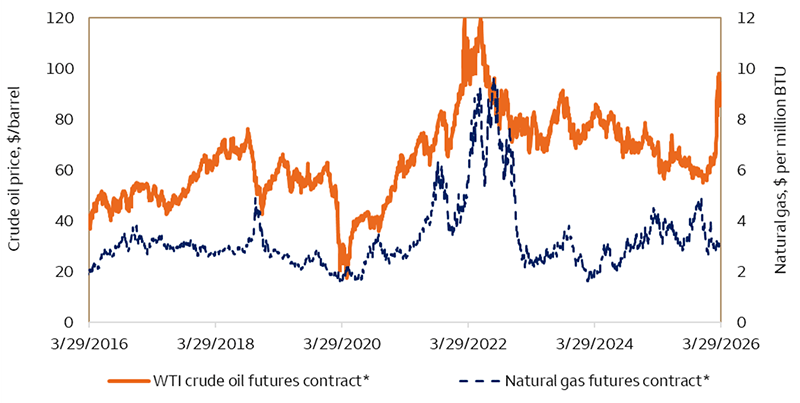 Sources: Bloomberg and Wells Fargo Investment Institute. Daily data, March 29, 2016 - March 27, 2026. Note: BTU is British thermal units. WTI is U.S. benchmark West Texas Intermediate crude oil. *Each futures contract is for delivery in the next month, the latest being for May 2026 delivery. Past performance is no guarantee of future results.
We see three important conclusions. The first is that even a temporary closure of the Strait is likely to impact energy and consumer prices through the supply chain into year-end. Second, offsets from disinflation trends already in place, along with the fact that U.S. natural gas prices remain flat, suggest a limited overall oil-driven inflation impact. A bump higher in inflation is likely to appear in economic data reports as soon as next month but should be limited in size and duration enough to keep the U.S. economy and earnings growth positive. Finally, in weighing this balance, our most important assumption is that the Strait does not remain closed for months.
What should investors do now?
Our thinking has not changed around this important assumption of the war’s impact on the Strait. We do not pretend to predict what will happen next, but we do reiterate the main point of our March 23 report, “don’t extrapolate” from the daily press reports. That’s because the two sides are adjusting to events in ways that can dilute the predictability of a single event. Our constraints-escalation framework still seems a useful framework to understand the adjustments and how they may affect the outlook.
Constraints: We view U.S. decision makers as increasingly concerned about the length of the Strait’s functional closure. Last week, the U.S. turned toward diplomacy, we saw the sharp selling as an investor demand for faster action to reopen the Strait. For their part, Iranian leaders seemed content to avoid any compromise, which prolongs the Strait’s closure and keeps pressures the U.S. and Israel. However, Iran is now reduced to raising fees for ship passage through the Strait. Meanwhile, CENTCOM reports describe the accumulating destruction of Iran’s military and defense-industrial capacity at a rapid rate. Our March 23 report offered specific details of the military and financial pressure we see building on Tehran.4
Escalation: There was no material escalation last week towards eliminating energy infrastructure around the Gulf countries. We note that Iran’s leaders might hesitate to initiate a strike on their Gulf neighbors in a way that invites back the same attack in retaliation. We believe the authoritarian regime in Tehran depends completely on oil revenue to maintain the security apparatus that holds them in power.
How we interpret the constraints and the escalation news: We see both sides still making adjustments to limit escalation while working against their constraints. While the pattern continues, we see several adjustments that we think make it unlikely that the conflict destroys the region’s energy facilities:
- Escalation remains proportional: Escalations have occurred since the war began. As we reported in earlier reports, Iran attacked its Gulf neighbors almost immediately after the war started, Iranian hackers broke into a U.S. company’s systems and, more recently, the two sides traded attacks on natural gas and metal processing factories. The latter two exchanges of strikes were the most serious instances so far but were “one and done”. Such calibrated retaliations may signal that the two sides are managing risk to keep the conflict below thresholds that accelerate retaliation.5 Iran may even see calibrated response as a tactic to prolong the war, while the U.S. may prefer proportional retaliation to limit oil price gains while planners seek tactics to open the Strait. Put another way, proportional responses make space for each side to adjust to its constraints. The risk remains, however, that factors that are difficult to predict in the fog of war could turn proportional into runaway escalation at some point.
- Negotiation may have many purposes: We see negotiations as another adjustment by the U.S. The negotiations were hard to follow last week, but that may reflect the chief U.S. negotiator’s style. Both on tariffs and with Europe on the Greenland question, our view is that President Trump started negotiations with a maximal bid and then negotiated lower. So, the variable rhetoric from the U.S. last week could be an adjustment to hurry a conclusion: part negotiating tactic, part testing the Iranian regime’s resolve, or part buying time for the U.S. military to prepare another and perhaps decisive operational phase. The diplomatic back and forth could help the U.S. buy time or recover the element of military surprise. In any case, each week we see the U.S. making adjustments to counter the pressure to “do something” to end the oil price spike.
Traditional hedging strategies in gold, U.S. Treasuries, defensive equity sectors and even a perceived global safe haven like the Swiss franc have not proven effective while oil prices rise but, again, tactics adjust in sometimes unpredictable ways. We view diversification and rebalancing as a more comprehensive risk management strategy that doesn’t attempt to guess the next adjustment or shock. But staying diversified historically has required some attention to rebalancing. This basic process involves selling assets whose prices appear to have outrun their fundamentals and reallocating the proceeds to cheaper looking assets whose fundamentals look solid. Our tactical guidance has employed this approach several times since 2023 around the ups and downs in technology-related sectors.
We see in this current market volatility a potential opportunity to rebalance and add from cash selectively depending on investment objectives and risk tolerance. In fixed income, we would focus on investment-grade maturities between 3-7 years. More generally, we favor rebalancing from the Energy commodity sector into the Precious and Industrial Metals sectors and, in the S&P 500 Index sectors, from Energy toward some combination of Financials, Industrials and Utilities. Investors may also consider restoring a market-weight allocation to the Information Technology equity sector, as well as a strategic portfolio weighting to Emerging Market Equities.
1 For more details, see CENTCOM’s reports. These are available through CENTCOM’s official website, and are distributed through official media channels, including DVIDS (Defense Visual Information Distribution Service), social media platforms, and YouTube.
2 For example, see Wells Fargo Investment Institute, “Iran war update: Don’t extrapolate,” March 23, 2026.
3 See Raj Patel, “The Persian Gulf oil crisis is a food crisis,” iPES Food, March 18, 2026.
4 See Wells Fargo Investment Institute, “Iran war update: Don’t extrapolate,” March 23, 2026.
5 Michael Mazarr, et al. “Understanding Escalation - a Framework for Evaluating the Escalatory Risks of Policy Actions,” RAND, May 27, 2025.
Risks Considerations
This commentary is for general informational purposes only, is not individualized investment advice, and should not be used as the sole basis for an investment decision. Views reflect conditions as of March 30, 2026 and may change.
Diversification cannot eliminate the risk of fluctuating prices and uncertain returns and does not guarantee profit or protect against loss in declining markets.
Each asset class has its own risk and return characteristics. The level of risk associated with a particular investment or asset class generally correlates with the level of return the investment or asset class might achieve. Stock markets, especially foreign markets, are volatile. Stock values may fluctuate in response to general economic and market conditions, the prospects of individual companies, and industry sectors. Foreign investing has additional risks including those associated with currency fluctuation, political and economic instability, and different accounting standards. These risks are heightened in emerging markets. Bonds are subject to market, interest rate, price, credit/default, liquidity, inflation, and other risks. Prices tend to be inversely affected by changes in interest rates. Although Treasuries are considered free from credit risk they are subject to other types of risks. These risks include interest rate risk, which may cause the underlying value of the bond to fluctuate. The commodities markets are considered speculative, carry substantial risks, and have experienced periods of extreme volatility. Investing in a volatile and uncertain commodities market may cause a portfolio to rapidly increase or decrease in value which may result in greater share price volatility. Investing in gold or other precious metals involves special risk considerations such as severe price fluctuations and adverse economic and regulatory developments affecting the sector or industry.
Sector investing can be more volatile than investments that are broadly diversified over numerous sectors of the economy and will increase a portfolio’s vulnerability to any single economic, political, or regulatory development affecting the sector. This can result in greater price volatility. The Energy sector may be adversely affected by changes in worldwide energy prices, exploration, production spending, government regulation, and changes in exchange rates, depletion of natural resources, and risks that arise from extreme weather conditions. Investing in the Financial services companies will subject an investment to adverse economic or regulatory occurrences affecting the sector. There is increased risk investing in the Industrials sector. The industries within the sector can be significantly affected by general market and economic conditions, competition, technological innovation, legislation and government regulations, among other things, all of which can significantly affect a portfolio’s performance. Risks associated with the Technology sector include increased competition from domestic and international companies, unexpected changes in demand, regulatory actions, technical problems with key products, and the departure of key members of management. Technology and Internet-related stocks, especially smaller, less-seasoned companies, tend to be more volatile than the overall market. Utilities are sensitive to changes in interest rates, and the securities within the sector can be volatile and may underperform in a slow economy.
Definitions
Consumer Price Index (CPI) produces monthly data on changes in the prices paid by urban consumers for a representative basket of goods and services.
Dow Jones Industrial Average is an unweighted index of 30 "blue-chip" industrial U.S. stocks.
NASDAQ Composite Index measures the market value of all domestic and foreign common stocks, representing a wide array of more than 5,000 companies, listed on the NASDAQ Stock Market.
Russell 2000® Index measures the performance of the 2,000 smallest companies in the Russell 3000® Index, which represents approximately 8% of the total market capitalization of the Russell 3000 Index.
S&P 500 Index is a market capitalization-weighted index composed of 500 widely held common stocks that is generally considered representative of the US stock market.
An index is unmanaged and not available for direct investment.
Investment Grade bonds - A rating that indicates that a municipal or corporate bond has a relatively low risk of default. Bond rating firms, such as Standard & Poor's, use different designations consisting of upper- and lower-case letters 'A' and 'B' to identify a bond's credit quality rating. 'AAA' and 'AA' (high credit quality) and 'A' and 'BBB' (medium credit quality) are considered investment grade. Credit ratings for bonds below these designations ('BB', 'B', 'CCC', etc.) are considered low credit quality, and are commonly referred to as "junk bonds".
General Disclosures
Global Investment Strategy (GIS) is a division of Wells Fargo Investment Institute, Inc. (WFII). WFII is a registered investment adviser and wholly owned subsidiary of Wells Fargo Bank, N.A., a bank affiliate of Wells Fargo & Company.
The information in this report was prepared by Global Investment Strategy. Opinions represent GIS’ opinion as of the date of this report and are for general information purposes only and are not intended to predict or guarantee the future performance of any individual security, market sector or the markets generally. GIS does not undertake to advise you of any change in its opinions or the information contained in this report. Wells Fargo & Company affiliates may issue reports or have opinions that are inconsistent with, and reach different conclusions from, this report.
The information contained herein constitutes general information and is not directed to, designed for, or individually tailored to, any particular investor or potential investor. This report is not intended to be a client-specific suitability or best interest analysis or recommendation, an offer to participate in any investment, or a recommendation to buy, hold or sell securities. Do not use this report as the sole basis for investment decisions. Do not select an asset class or investment product based on performance alone. Consider all relevant information, including your existing portfolio, investment objectives, risk tolerance, liquidity needs and investment time horizon. The material contained herein has been prepared from sources and data we believe to be reliable but we make no guarantee to its accuracy or completeness.
Wells Fargo Advisors is registered with the U.S. Securities and Exchange Commission and the Financial Industry Regulatory Authority, but is not licensed or registered with any financial services regulatory authority outside of the U.S. Non-U.S. residents who maintain U.S.-based financial services account(s) with Wells Fargo Advisors may not be afforded certain protections conferred by legislation and regulations in their country of residence in respect of any investments, investment transactions or communications made with Wells Fargo Advisors.
Wells Fargo Advisors is a trade name used by Wells Fargo Clearing Services, LLC and Wells Fargo Advisors Financial Network, LLC, Members SIPC, separate registered broker-dealers and non-bank affiliates of Wells Fargo & Company.